25 Principles of the Playa
A Newcomer's and Ex-Virgin's Guide to Burning Man
I couldn't start this book with any other phrase. I had to put it right here, at the very beginning, to remind you: Burning Man is not a festival. What is it, then? Every person finds their own answer to that question.
But what is this book about? Let me explain.
This isn't a survival guide. There are plenty of those — they'll tell you how much water to bring and what sunscreen to use. This is something different. This is about how to actually experience Burning Man. How to let it in. How to not waste seven days in the desert doing the same things you'd do at home.
Before you start reading, there's one vital rule you need to know: don't build expectations. Not about this book, and certainly not about the Burn itself. It's easier said than done, but it's the truth. Burning Man is wildly different for everyone. My experience is my experience. Your experience will be entirely your own. Nothing ruins the Playa faster than having a picture in your head of how it's supposed to be. If the reality turns out even slightly different, it will shatter your experience. Do not build expectations about what should or shouldn't happen. Be as radically open as possible to whatever comes your way (within reason). If you do that, you're going to be fine.
"You don't get the Burn you want; you get the Burn you need."
These 25 principles were born from real burns, real mistakes, real magic. Some of them will make sense before you go. Most of them will only click when you're out there. Read them now. Read them again on the playa. And then throw this book away and live it.This book started as a gift for Olexi Malytskyy, who taught me his first ten principles. After my first burn, I started adding my own observations. After my second, the list grew to 25. I'm sure after my third, there will be more.
What began as a thank-you to Olexi — my gratitude for this incredible experience he opened up for me — eventually grew beyond a personal gift. When the content crossed a certain size, I decided to share it with the world. So I shaped it into this format, and I hope you'll find it useful. Just know that everything here is based on my own two burns, my own observations, written for newcomers by someone who was one not long ago.
The 25 Principles
- 1. Embrace the Zigzag
- 2. Release the Clock
- 3. Move Slowly, Look Around
- 4. Master Your Bike
- 5. Don't Bring What You Fear to Lose
- 6. Pick Up MOOP
- 7. Just Ask
- 8. Allow Yourself to Find
- 9. Find Your Language with the Playa
- 10. Ask for Your True Wishes
The first 10 principles are the ones Olexi taught me. I agree with every single one from my own experience. What follows are my own additions - born from two burns of discovery.
- 11. Leave the Screen Behind
- 12. Follow the Flow, Not the Schedule
- 13. Always Walk Toward the Playa
- 14. Trust the Pace
- 15. Skip the Line, Find the Magic
- 16. Walk When You Can
- 17. Pay a Visit to the Man and the Temple
- 18. Sunrise at Trash Fence
- 19. Get Lost at Night
- 20. Go Naked and Barefoot
- 21. Climb on Things
- 22. Playa Gifts Are Real
- 23. Write Everything Down
- 24. Follow the 10 Principles
- 25. Two Weeks of Grace
Prologue
I first heard about Burning Man as a teenager. Even back then, I knew I would go someday. But when I actually moved to the US and lived in LA for two years, I kept putting it off. The timing never felt right — especially with the war going on back home in Ukraine.
Then, in 2024, I was at a friend's BBQ. A few of us were grilling our friend Olexi about the playa. I asked him some random logistical question, and his answer caught me completely off guard.
"Andrew, none of that matters," he said. "Just tell me one thing: do you want to become a new version of yourself?"
"Yes."
"Then go to Burning Man. That's it. Nothing else matters."
So I went. And on my very first burn — right in the middle of intuitively doing the exact things that would later become Principle #8 — I ran into Olexi out in the dust. He took me under his wing, showed me the playa through his eyes, and taught me a few essential rules of survival.
In this book, I want to share those initial 10 pieces of advice he gave me, along with 15 of my own that the desert taught me along the way.
Those principles I wrote to myself, those are mine, and I just wanted to share them with you. You might find yours. I encourage you to! Please share them with me when you do!
Embrace the Zigzag
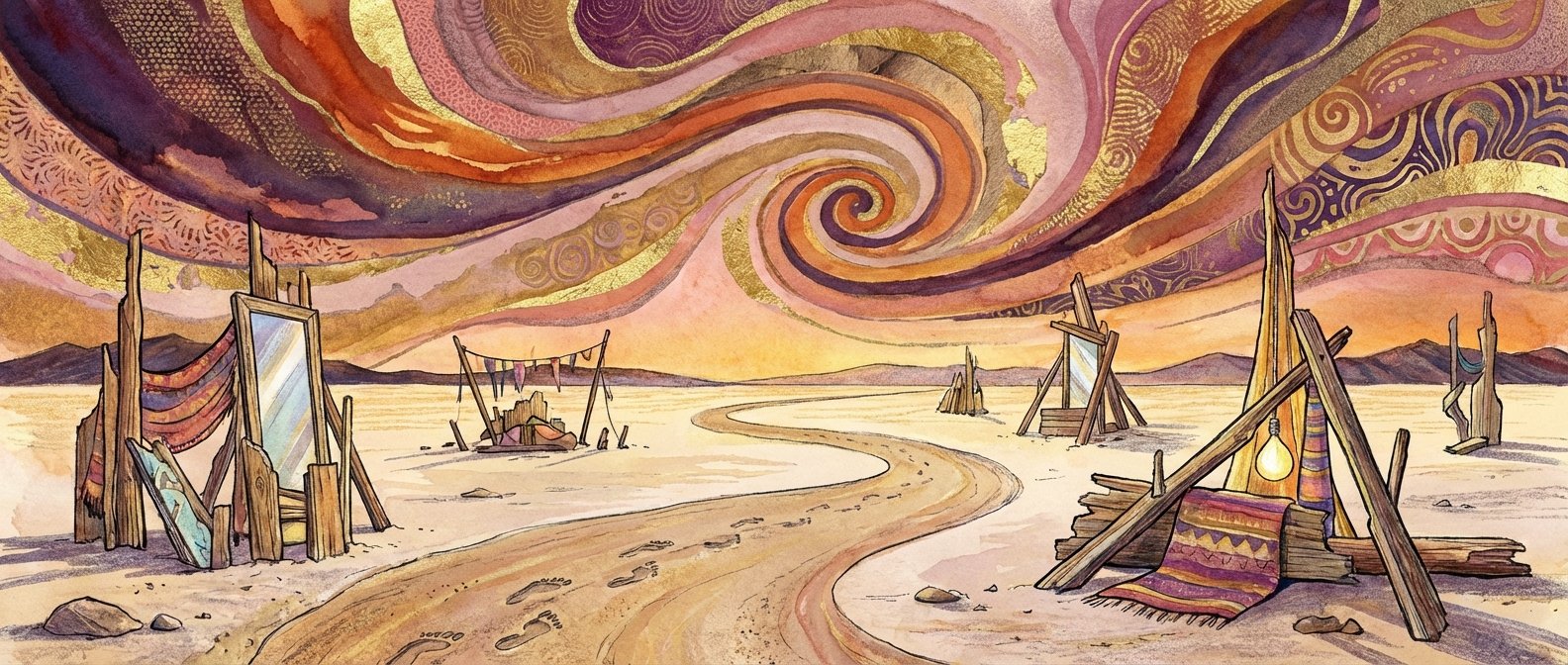
The worst thing you can do on the playa is know exactly where you are going. Black Rock City is built on a perfect grid, complete with streets and addresses. It tricks you into thinking it's a normal place that should be navigated like one — Point A to Point B. But the moment you start walking in a straight line, you stop seeing what’s around you.
Walking in a straight line means you have a destination. And destinations are the enemy of discovery on the playa. The art installation you'll remember for the rest of your life is 40 feet to the left of your "efficient" path. The conversation that changes your perspective is happening at the camp you almost walked past. The moment that breaks you open is never where you planned to be.
Zigzag. Wander. Let something catch your eye and follow it. If you see lights in the distance, go toward them. If you hear music that pulls at you, follow the sound. The playa rewards curiosity, not efficiency. You have a whole week. You don't need to optimize it.
✦ Personal Story
I've always optimized my time. Shortest path from A to B, maximum efficiency, no wasted minutes. And when I first got to Burning Man, I did the same thing — head down, straight lines, fastest route.
Then I started riding with Olexi.
He's a veteran — multiple burns, knows the place inside out. But he zigzags. Constantly. He'd veer off toward something I wouldn't even notice — a tiny art piece, a random structure, something half-hidden behind a larger installation. Every single time we stopped, something incredible happened. A conversation, a moment, a piece of magic that wouldn't have existed if we'd stayed on the straight path.
So I started doing it myself. And the quality of my experience changed dramatically. Not that it was bad before — but when I stopped walking straight and started wandering, the playa moments multiplied. I'd think about someone and run into them at the next turn. I'd stumble into the exact conversation I needed. Things that felt impossible started feeling inevitable.
Efficiency is the default world's drug. When I first wrote this, I thought the rule was universal: "everyone must wander around." But when I shared it with some friends, they laughed. "Andrew," they said, "we wander around all year. For us, walking in a straight line with focus was the revelation."
That's when it clicked. The core lesson isn't actually about the zigzag. The lesson is: Do the opposite of your default world pattern.
The playa is a giant sandbox for adults — an adult kindergarten. Doing the opposite of what you normally do is what violently expands your boundaries. If you're a Type-A optimizer, it teaches you the zigzag. If your default mode is chaos, it might teach you the profound magic of a straight line.
Release the Clock
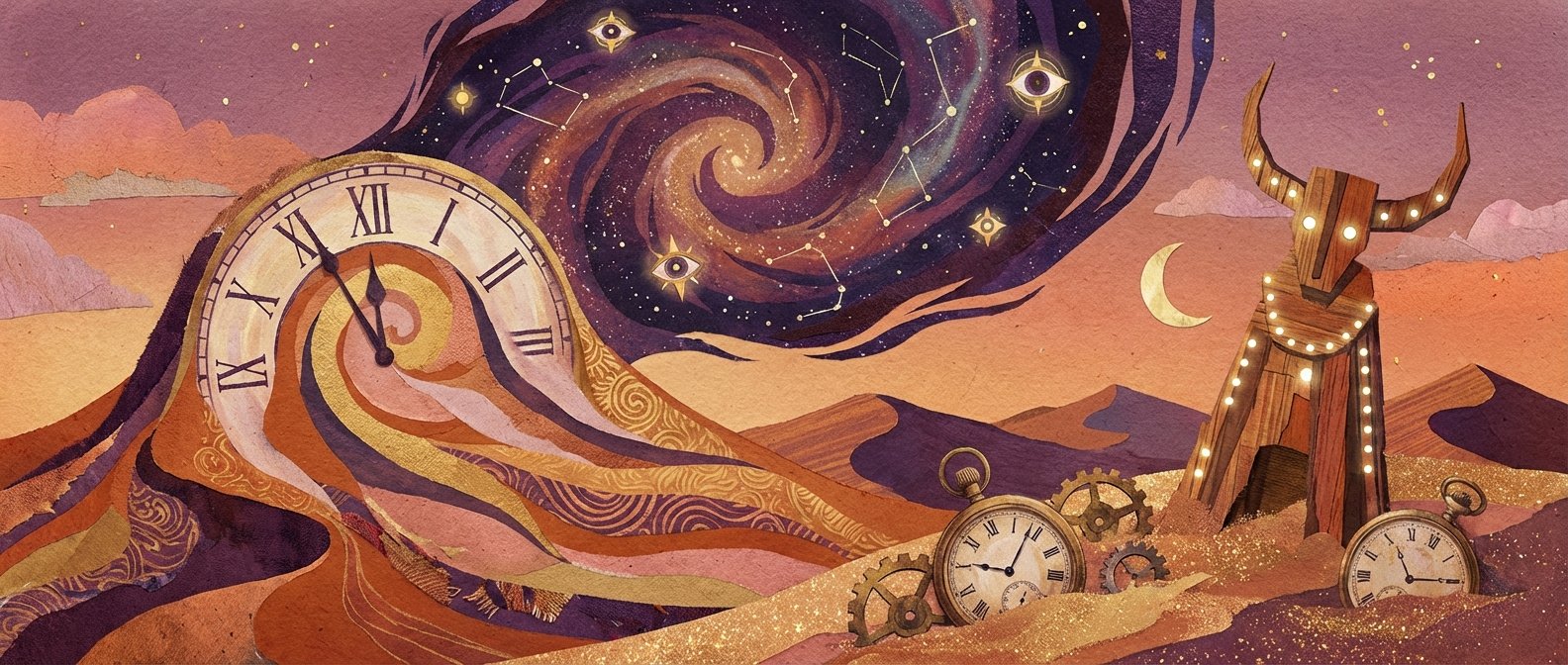
Take off your watch. Seriously — take it off before you drive through the gate. Put your phone on airplane mode (more on that later). Let go of the concept that 2pm means anything.
In the default world, time runs your life. Meetings at 10, lunch at 12:30, dinner reservation at 7. On the playa, time dissolves. You eat when you're hungry. You sleep when you're tired. You dance until your body says stop, and sometimes that's at 4am, sometimes at 4pm. The sun becomes your only clock — and even that becomes negotiable after a few days.
This is harder than it sounds. You'll feel the phantom itch of "what time is it?" for the first day or two. Your brain will try to schedule itself. "We should head to that sound camp by 8." Let it go. The moment you release your grip on the clock, the playa starts operating on a different frequency. Things happen when they're supposed to. You arrive at the right place not because you timed it, but because you were open.
Veterans call it "playa time." It's not laziness — it's presence. And presence is the whole point.
✦ Personal Story
At the gate, they hand you a booklet with the event schedule. Something like 5,000+ listed events — and I'd estimate for every planned event, there are another 10-20 that aren't in any booklet. So you're looking at maybe 70,000 things happening across the week, most of which nobody wrote down.
The first time, we tried to follow the booklet. Plan our days. Be at the right place at the right time. It almost never worked. Events rarely started when they were supposed to. Monday through Wednesday, the schedule was somewhat accurate. By Friday and Saturday — nothing happened anywhere close to the listed time.
DJs on art cars were the worst. Desert logistics are brutal — things break, generators fail, the dust gets into everything. We once waited over three hours for a DJ who was supposed to start at 2am. He finally got on stage at 4:30am. The moment — the exact moment — he pressed play, the entire art car went dark. Power cut. Everything dead. They couldn't restart it, and he walked off. He ended up playing at 7am when they fixed it, but by then we'd already wandered off into something else entirely.
That's when I stopped tracking time. The clock is a trap on the playa. Every time I tried to sync with it, something went sideways. Every time I ignored it, the right thing found me.
Move Slowly, Look Around
Move slowly, pedal slowly, look around.
Everyone's first instinct on the playa is to rush. There's so much to see, so much happening — you feel like you need to cover ground. The FOMO is real. There are tens of thousands of events happening at the same time. Accept right now that seeing even 10% of everything is physically impossible. You won't. Nobody does. The faster you move, the easier it is to miss what's right next to you. And remember — there is no time on the playa. You'll arrive where you need to be, when you need to be there. Don't rush it.
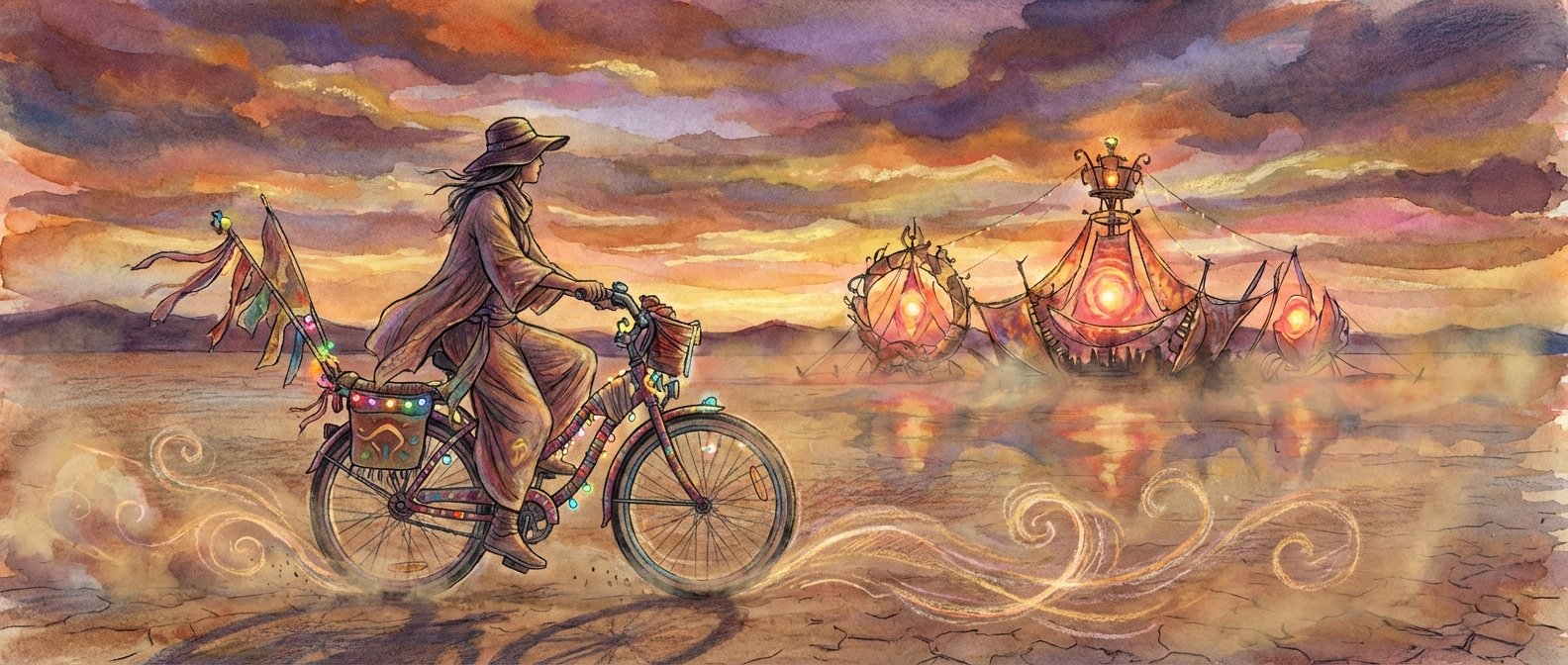
If you have an e-bike, turn off the assist. Pedal. Work your legs. Or better yet — walk. The slower you move, the more the playa reveals. You'll see people sprinting on bikes from one end of the city to the other, heads down, pedaling hard, missing everything.
Don't be that person.
Slow down. Especially on your bike. The playa is not a race. When you pedal slowly, you notice things. The tiny art piece someone spent six months building, sitting quietly between two massive installations. The couple slow-dancing to no music in the middle of an empty stretch of desert. The sunset light hitting the dust in a way that makes the whole world look like a painting.
There's also a practical side: the playa surface is uneven, cracked, and sometimes soft. Riding fast means eating dust — literally. At night, it's even worse. Visibility drops to almost nothing in a whiteout, and bikes become dangerous projectiles. Slow pedaling saves ankles, saves bikes, saves faces.
But mostly, slow down because fast is what you do at home. Speed is the default world's drug. Out here, you're detoxing.
✦ Personal Story
My first burn, I skipped most of the art. I was too busy chasing other things — parties, people, experiences. My second burn, I told myself: this year, I want to see more art. I shifted my time away from dancing under DJs and toward exploring installations.
When I got home and looked at the full art list with photos, I realized that even with a deliberate focus on art, I'd still missed a good chunk of it. The playa is just that big. And here's the thing — some art is only up for a single day. Some gets burned before Thursday. You think you'll catch it Friday or Saturday, but it was already ash by Wednesday. You can't see it all. But you can see what's meant for you — if you slow down enough to notice it.
Master Your Bike
Park your bike nose-first into an art car.
This sounds like a small thing. It's not.
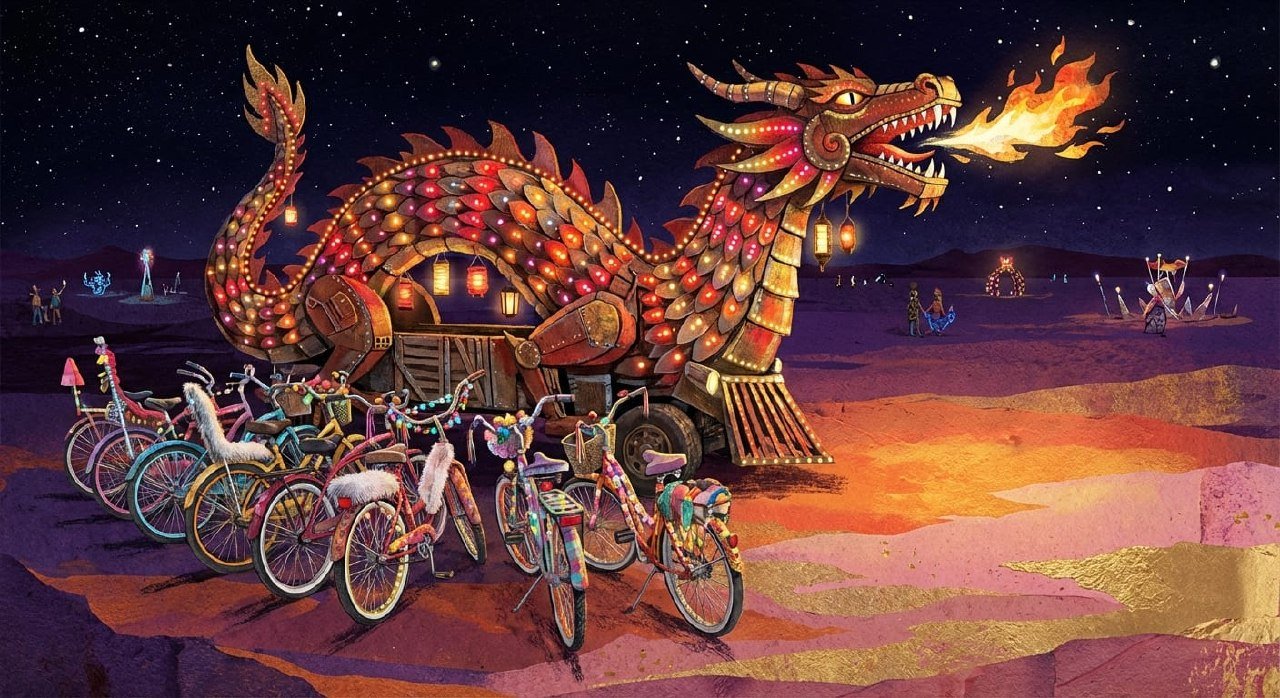
Art cars — mutant vehicles, as they're officially called — are mobile art installations. Some are 40-foot dragons breathing real fire. Some are pirate ships on wheels. Some are just pickup trucks covered in fur and LEDs. They roam the playa carrying passengers, playing music, creating rolling parties.
When you pull up to an art car on your bike, park it nose-first — front wheel pointing into the vehicle. Not parallel. Not facing out. Nose in.
To be fair, this might sound more like a pro-tip than a profound life principle. But here is why it became a principle for me: every single time I ignored this rule, something bad happened. Every time I thought "it doesn't matter how I park," the playa punished me with tangled pedals, chaotic escapes, or lost time. It became a language I spoke with the desert — a small ritual of respect.
When you park nose-first, you create an orderly ring. When the art car suddenly decides to leave (and they do, often without warning), you just grab your handlebars and pull your bike backward into the open desert. It's safe, it's practical, and most importantly — it's how you avoid the wrath of the playa.
Also: remember where you parked. In the dark, with a hundred bikes around a single art car, they all look the same. Decorate your bike. Put lights on it. Make it recognizable. There are 60,000+ bikes on the playa. Yours needs to stand out. As Olexi recommends, buy a big fluffy toy and zip-tie it to your bike frame so you can easily recognize yours. And consider a basket — it might not look fancy, but it's incredibly convenient for carrying things around.
Lock the rear wheel with one very simple code and always in one motion.
Bike theft on the playa is... complicated. Most of the time, it's not theft — it's "borrowing." Someone needs to get home at 4am, they're exhausted, and your unlocked bike is right there. They ride it to their camp and forget about it. Your bike is now a mile away at a camp you'll never find.
The solution is dead simple: a basic combination lock on the rear wheel. Not a $60 Kryptonite U-lock — just a cheap cable lock with a simple code. Something you can operate "un-sober" at 3am in a dust storm. Use the same code for everything — your bike, your lock, whatever. Keep it to 3-4 digits you'll never forget. The lock doesn't need to be strong enough to stop a determined thief. It just needs to make it slightly harder to ride away than the unlocked bike next to yours.
Lock the rear wheel because it immobilizes the bike. Someone can still pick it up, but they can't ride it. One motion — wrap, click, done. Don't fumble. Don't overthink. Make it muscle memory.
And put your playa name and camp address on the bike. If it does wander, someone might bring it back.
Don't Bring What You Fear to Lose
Don't bring anything you are afraid to lose. And this applies to everything — from physical objects to relationships and parts of your identity.
On the surface, this is about physical gear. The playa is a harsh, unforgiving environment. Fine alkaline dust gets into everything. Things break, things wander off, things get ruined. If you bring your favorite expensive sunglasses, you will probably scratch them beyond repair. If you bring a vintage heirloom jacket, it might get torn. If you're constantly worried about keeping a precious item safe, you aren't present. You're guarding an object instead of experiencing the city. Bring things that serve you and make you look fabulous, but make sure they are things you can laugh about if they get destroyed.
But the principle goes much deeper than expensive cameras or favorite jackets. It applies to the mental and emotional baggage you bring with you.
If you bring a relationship that is fragile, the playa will test it. Burning Man is a pressure cooker that amplifies whatever cracks already exist. If you bring your ego, your professional title, or the carefully curated image of who you think you are — be prepared for the desert to strip it away.
If you are afraid to lose a certain version of yourself, don't bring it to the playa. Because the reality is, there is a very high risk that you will lose it. Burning Man changes people. If you want to become a new person, you have to be willing to let the old one stay behind in the default world.
Acceptance of loss is part of the burn. Let go of the attachment — both material and mental — before you even pack the car.
✦ Personal Story
Before my first burn, Olexi warned me about this principle. So I was careful. I didn't bring anything I would regret losing. In fact, I intentionally left certain things at home specifically because I was afraid of losing them in the dust. From a material standpoint, I was perfectly prepared.
But here is what I didn't know: the same rule applies to the things you find out there.
On the playa, I deeply reconnected with someone I had known for a while. We spent incredible, meaningful time together. But after the burn, we never spoke again. In a sense, I lost an acquaintance. Sometimes, memories of that connection still bring me a lingering discomfort.
So while this principle warns you not to bring what you fear to lose from the default world, my biggest realization was that you also have to be mentally prepared to leave behind the things you find on the playa. Some connections, just like physical objects, belong to the desert. And you have to make peace with the fact that you can't bring them back.
Pick Up MOOP
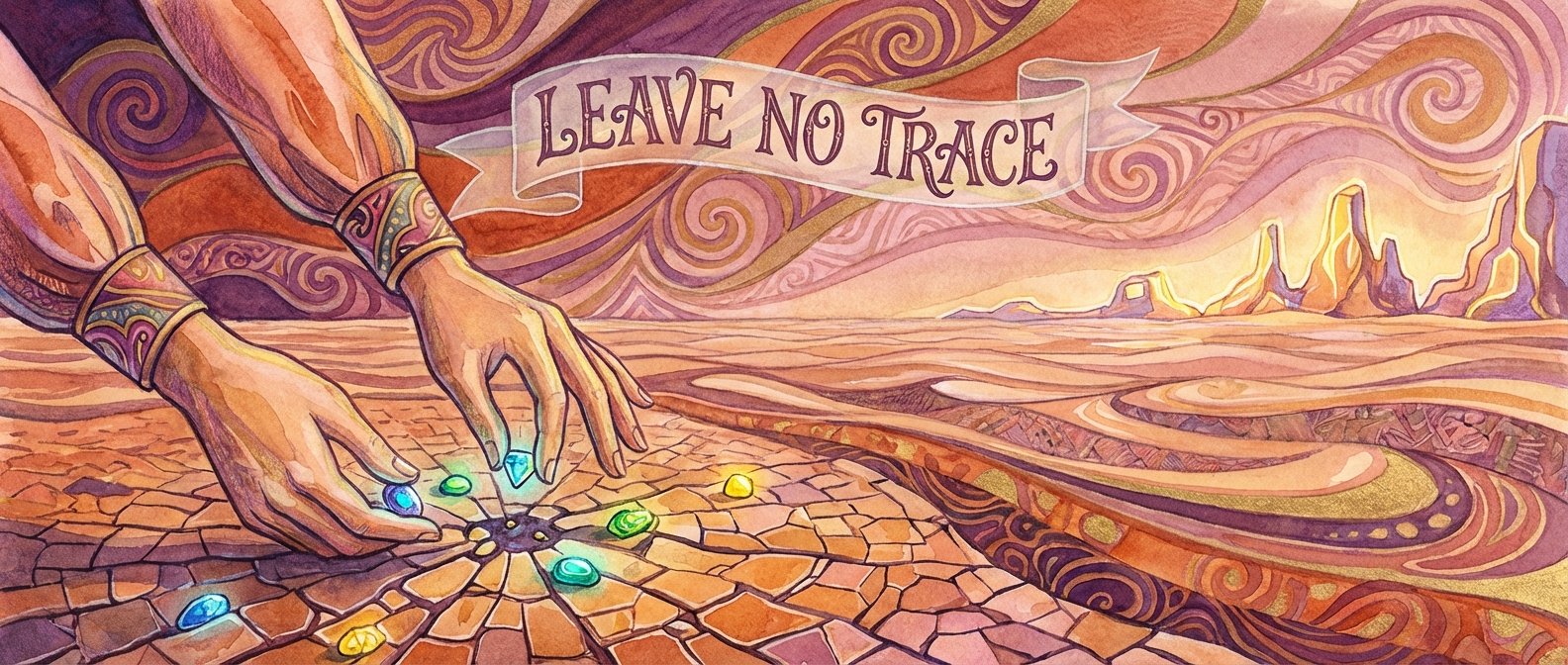
Pick up MOOP, but don't chase every piece of trash or you'll just be stupidly chasing trash. But what resonates with you — pick it up, especially in deep playa.
MOOP — Matter Out Of Place — is Burning Man's term for anything that doesn't belong on the desert floor. A bottle cap. A feather from someone's costume. A zip tie. A piece of glitter. Anything that wasn't there before 70,000 people showed up.
Leave No Trace is one of the 10 Principles, and on the playa it's practically a religion. After the event, the Bureau of Land Management inspects every square foot of the desert. Camps that leave MOOP get flagged. Repeat offenders lose their placement. The community takes this dead seriously — and you should too.
But here's the nuance: you can't pick up every piece of trash you see, or you'll spend your entire burn staring at the ground. That's not living. The balance is awareness without obsession. When you see something — especially in deep playa where there are fewer people and every piece stands out more — pick it up. Carry a small bag in your pocket for this. Make it a habit, not a mission.
And there's A LOT of it. I consistently fill a bag every half day — there's too much to obsess over. So I focus on what matters most: things that will be hard to find later if you don't grab them now, and things that spread with the wind. And speaking of things that spread: NO glitter. NO feathers. Please. They are absolute MOOP nightmares because they shed constantly from your body and scatter everywhere. Leave them at home.
Another practical tip: if it rains, do not put plastic trash bags over your shoes. People think it's a clever way to keep clean, but the bags tear easily, get embedded deep in the sticky clay mud, and then it's nearly impossible to rip them out when the playa dries. You'll just be leaving pieces of plastic everywhere. Stock up on cool rubber shoe covers instead.
And here's something newcomers don't always realize: there are no trash cans at Burning Man. None. Everything you bring in, you take out — including other people's MOOP. All of it goes home with you.
Some burners do organized MOOP sweeps — walking in a line across the desert, shoulder to shoulder, combing the ground. It's meditative, communal, and surprisingly satisfying. Join one if you get the chance. But day-to-day, just be conscious. The playa is borrowed land. Leave it cleaner than you found it.
✦ Personal Story
I don’t chase every single piece of trash on the playa. I have my own specific theme.
Ever since I was a kid, I’ve loved building things. Construction sets, electronics, LEGOs, tools — those are my best childhood memories. Even now, I still love sitting down to build a complex LEGO set.
So when I’m on the playa, my MOOP bag is reserved for construction and electrical debris. If I see a stray nut, a bolt, a zip-tie, a piece of wire, or a dropped tool — that’s my treasure hunt. That’s what goes into my bag.
Everyone finds their own way to do it. You don’t have to pick up everything. Pick your theme, make it a game, and suddenly cleaning up the desert isn’t a chore anymore — it’s part of the experience.
Just Ask
If you need something — ask the person next to you.
One of the 10 Principles says Radical Self-reliance. So here I am telling you to ask other people for help. Sounds contradictory, right?
Here's how I see it. Radical self-reliance can mean bringing every possible tool, spare part, and backup plan. But that's impossible — you can't pack for every scenario. You'd need every screwdriver size, spare bike parts, a soldering iron, duct tape in three colors, and a field surgery kit.
Or you can take radical self-reliance in a different direction: rely on your own ability to communicate. Trust that you can ask for what you need and that the playa will provide — through other people.
This isn't about showing up empty-handed. Bring your stuff. Be prepared. But when something breaks and you don't have the right tool — just ask.
✦ Personal Story
Olexi's film camera broke on the playa. He needed tweezers to fix it. Tweezers. In the middle of a desert.
He comes to me and says, "Andrew, you definitely have tweezers." I say, "Bro, where would I have tweezers? We're on the playa." He insists: "No, I know you have them." I looked through my stuff, didn't find them. We found a small screwdriver instead and fixed the camera with that.
But later, digging through my toolbox, I actually found tweezers. They were there the whole time. I just hadn't looked carefully enough. Olexi was right.
I noticed he did this with other people too — asking with total confidence that they had exactly the thing he needed. And somehow, they always did.
Later, I needed a soldering iron. A soldering iron — on the playa. I asked a random neighbor. They had one. Of course they did.
Sometimes, just ask.
Allow Yourself to Find
Don't search (but allow yourself to find).
It sounds like a paradox, but it’s an absolute truth of the Playa: the moment you desperately start searching for something, you stop noticing everything else. Your brain switches into laser-focus mode on one specific goal — finding a certain person, a specific party, a lost item — and everything else simply becomes an obstacle in your way. You waste hours, walk in circles, get frustrated, and ultimately feel completely drained. An intuitive sense that "something is wrong."
The Playa doesn’t like it when you try to control it. Every time I simply followed my desires, I found incredible things, met amazing people, and got exactly what I needed. But every time I specifically went looking for something — it was a disappointment.
You'll hear this phrase over and over from veterans: "The playa provides." It sounds like new-age nonsense until it happens to you. You'll be wandering aimlessly and stumble into the exact conversation you needed to have. You'll be thinking about someone and they'll appear at the next intersection. You'll need something — a tool, a piece of advice, a hug — and it'll materialize from nowhere.
This isn't magic (or maybe it is — jury's out). It's what happens when 70,000 people create a city built on radical generosity in the middle of nowhere with no commerce, no phones, no social media, and no agenda. Serendipity becomes the operating system. But it only works if you stop trying to force it.
But let's be honest — what if the "playa provides" thing never happens? You give up, stop looking, let go... and nothing happens. That's super disappointing. But that's the point: the playa isn't a magic vending machine. Sometimes it doesn't provide what you asked for, but what you actually needed. And sometimes, the lesson is the disappointment. It teaches you how you handle not getting your way.
✦ Personal Story
Once, a friend and I spent two hours desperately looking for his lost driver's license. Two hours of wandering in the dark of night. Of course, we found nothing. Eventually, we just gave up and decided to head to a location where we were supposed to meet some other friends. They had given us a specific address where they would be. The moment we let go of that tension, we just started chatting, laughing, and cruising between camps having a great time.
And you know what happened? At one random intersection, we completely "accidentally" ran into our friend. She had stepped out of the location where everyone was hanging out at that exact second to cross the street because something in the opposite camp caught her eye. We crossed paths. She said, "Oh, hey! We're actually hanging out right here!" It turned out they had given us the wrong address earlier, and the place we were originally heading to was empty. If we hadn't given up our focused search and relaxed, we would never have intersected with her at that exact right second.
P.S. He successfully got his driver's license back on the second-to-last day from the Lost & Found at Center Camp.
So if you really need to find something — check out Chapter 10 ("Ask for True Desires"). But the baseline rule is this: stop searching. Let it go. The thing you need will find you the moment you stop looking at the world through the narrow keyhole of your own agenda.
Find Your Language with the Playa
Find your own language of communicating with the playa and its signs, and how to read them.
This is where Burning Man gets weird — beautifully, unforgettably weird.
The playa talks to you. Not in words. In coincidences, synchronicities, patterns, moments that are too perfectly timed to be random. You'll be wrestling with a question in your head and walk past an art piece with the answer written on it. You'll feel pulled in a direction for no reason and find exactly what you needed. You'll see the same symbol three times in a day.
Every burner develops their own way of reading these signs. For some it's visual — they follow colors or shapes. For others it's emotional — they follow what makes them feel something. Some people talk to the playa out loud, like a prayer. Some write in journals. Some just listen.
The key word here is "your own." Nobody can teach you this language. You can't read about it in a guide (including this one). You have to develop it through direct experience. Pay attention. Notice patterns. And don't dismiss anything as coincidence too quickly.
The rational part of your brain will resist this. Let it resist. You don't need to believe in anything mystical. Just stay open. The playa is a mirror — it reflects what you bring to it. Bring openness, and you'll be amazed at what you see.
✦ Personal Story
My own language with the playa overlaps heavily with the "Don't Search" and "True Wishes" rules. But to explain it practically, it comes down to a mental experiment I once did. I asked myself: What do I regret more in life? The times I wanted to do something but didn't? Or the times I wanted to do something, did it, and it turned out to be a mistake?
The answer was clear: I always regretted the things I didn't do far more.
So I made a rule for myself on the playa: I will listen to my brain, my thoughts, and my heart. And I will act the exact second a thought arrives. If I feel a sudden pull to go somewhere, to talk to someone, to look at something, or to do a specific action — I do it immediately.
Where does that thought come from? Is it because I read a "sign"? Is it because I saw an art car? Because I remembered a person? That's secondary. The only thing that matters is that once the impulse arrives, I must act on it.
So while others might literally "read signs" in the dust, my language with the playa is entirely internal. Something inspires me, a thought drops into my head, and I instantly put it into motion.
Others have completely different languages. For example, a group of three of my friends ride around the playa at night looking for adventures. They take turns leading the group. Whoever is leading picks a random art piece somewhere in the distance, and they all ride toward it.
But here is their rule: once they arrive at the art piece, they have to figure out why they were brought there. They look at the environment, talk to a stranger, read the inscriptions, and try to find the hidden meaning or lesson in that specific place. Then the next person leads them to a new spot, and they do it again.
That's their game. Everyone finds their own frequency.
Ask for Your True Wishes
Ask the playa for your true and genuine wishes.
This isn't about rubbing a lamp and hoping for a genie. It's about clarity.
The Playa is like a big deck of metaphorical cards. Each person interprets them in their own way, filtering these symbols through their own experience, knowledge, intuition, and the questions that bother them personally. It takes whatever is inside you and amplifies it by a hundred. If you come with anxiety, you'll find reasons to be anxious. If you come with judgment, you'll find people to judge.
Before you go to Burning Man — or early in the burn, when the dust hasn't fully settled into your lungs yet — sit with yourself and ask: what do I actually want? Not what you think you should want. Not what would look good on Instagram (which you shouldn't be on anyway). What do you genuinely, truly need right now in your life?
The playa has a strange way of answering honest questions. But the key word is honest. If you ask for surface-level things — "I want to have fun," "I want to see cool art" — you'll get surface-level answers. If you ask for real things — "I need to forgive someone," "I need to figure out what I'm doing with my life," "I need to feel something again" — the playa goes to work.
Write it down. Put it in your notebook (Chapter 23 will tell you why). Say it out loud in the Temple. Whisper it to the Man. The form doesn't matter. The honesty does.
✦ Personal Story
My method is simple. Almost stupidly simple.
When I want something — food, finding a friend, answers to my deepest questions — I ask the playa. One ask. Clear, specific, concrete.
And then, since I can't search (that's the whole point of Chapter 8), I follow the most basic human needs instead. I'm thirsty — I go find a drink. I need shade. I need to pee. I want to see some art. Something simple, something physical, something real.
If I feel like I want silence, I immediately go look for silence — even if my absolute favorite DJ is playing their top track right in front of me.
If I want to be warm, and a massive show is about to start in five minutes — I turn around and go put my coat on.
If I feel bored, I just change my location.
I try not to second-guess myself or negotiate with my simple, naive desires. If I want something basic, I try to make it happen immediately. And inevitably, the path to getting that simple thing leads me straight into the experiences I secretly wished for — or the ones I never expected at all.
I start moving toward that simple goal. And on the way there, wandering, not searching — the thing I actually asked for shows up. Incredibly delicious food appears out of nowhere. A best friend I haven't seen in years and wanted to talk to is suddenly standing right there. The answer to my question comes through a casual conversation with some random dude in the dust.
Every single time. Not because it's magic — or maybe exactly because it is.
Chapters 1 through 10 are built on the advice my friend Olexi Malytskyy gave me before my very first burn. I ran his words through the filter of my own experience and shaped them into what I call the "10 Principles of Olexi Malytskyy." He never actually called them that, but I like to think of his wisdom this way. They kept me sane. They guided my experience.
But when I returned to the playa for the second time, I realized the desert had taught me things I couldn't find on any list. The next 15 chapters are mine. This is what the playa taught me.
Leave the Screen Behind
Don't use the internet or your phone.
Put it in your tent. Better yet, put it in a sealed bag in your tent. Keep it for emergencies — communicating with campmates, actual safety situations. Otherwise, it doesn't exist for a week.
My opinion — if I may — this is non-negotiable if you want to actually experience Burning Man.
Here's what happens when you have your phone: you photograph instead of experiencing. You check the time (Chapter 2 says don't). You open apps out of muscle memory — Instagram, WhatsApp, email — even when there's no signal. Your brain stays tethered to the default world. You're physically on the playa but mentally somewhere else.
There's usually minimal cell service anyway (though it's gotten better in recent years — one more reason to hide your phone). But even if you had perfect 5G, you should ignore it. The playa is one of the last places on earth where you can fully disconnect, and that disconnection is where the transformation happens.
You won't miss anything important. The default world will survive without you for a week. It always does. And you'll come back different — actually different, not Instagram-different — because you gave yourself the gift of being unreachable.
And the playa has a sense of humor about this. One of the most brilliant art installations I've seen was a cage — literal metal bars — with free Starlink WiFi inside. To get the password, you had to walk in and close the gate behind you. So there you are, locked in a cage on the playa, scrolling your phone while the entire desert lives and breathes around you. The irony is the art.
There's also a camp called "Free WiFi." I'll let you discover what that means when you get there. Wink wink. 😉
As for photos — there are a million friends around you who will happily take your picture if you ask. You don't need your phone for that.
✦ Personal Story
I put my phone in my backpack when I pull into the gate line. I take it out when I drive out of Burning Man. For the entire week in between, I don't touch it.
I run a company. My family is in Ukraine — a different country, a war zone. The instinct to check in is real. But here's how I handle it: I know that in my camp, there's always someone with connectivity — a camp manager, a logistics lead, someone who has signal for operational reasons. That person is my emergency contact. My assistant and my family know that if something truly urgent happens, they can reach that person, and that person will find me on the playa and deliver the message.
Considering that getting out of Burning Man to civilization takes time anyway, a delay of half a day to a full day won't change anything. If my emergency contact hasn't come looking for me — everything is fine. No news is good news.
That's my system for being completely offline while knowing that if the world actually needs me, it can reach me. The peace of mind this gives is worth more than any notification.
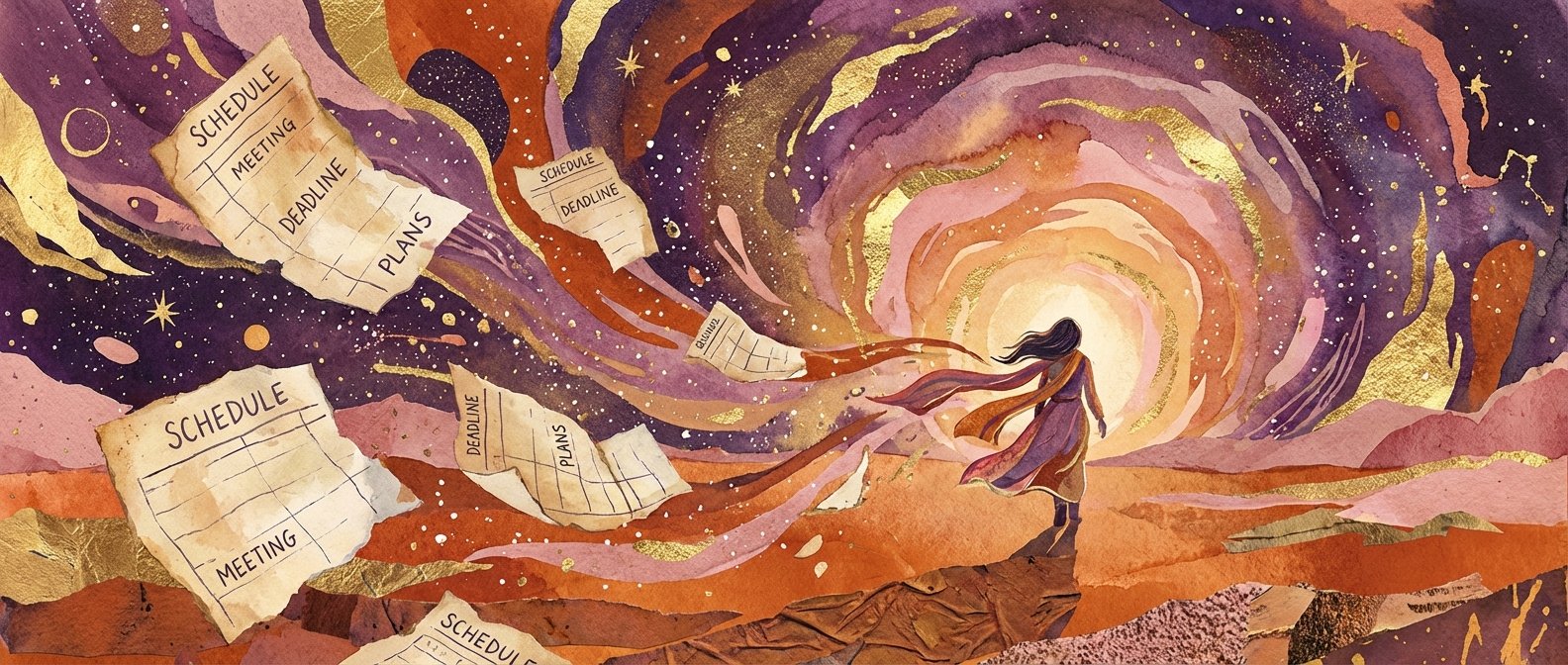
Follow the Flow, Not the Schedule
Don't plan and don't make a schedule.
This reinforces Chapters 2 and 8, but it's important enough to be its own principle.
Before the burn, you'll be tempted to go through the event guide — and yes, there is one: hundreds of pages of workshops, talks, parties, screenings, ceremonies. You'll want to highlight your favorites, map out your days, build an itinerary. Resist this.
Plans create expectations. Expectations create disappointment. On the playa, the best things happen when you're open, and openness requires not having a plan that you're constantly measuring reality against.
This doesn't mean you should ignore the event guide entirely. When you drive through the main gate, the greeters will hand you this thick book (the "What Where When"). It really is full of incredible things. I highly recommend flipping through it — look at the cool events, see what different camps specialize in, and read what they’re inviting you to experience. Notice if something genuinely calls to you. But whatever you do, do not get obsessed with the schedule. Make a mental note of what sounds interesting, but then let it go. If the Playa wants you there, you'll end up there. If you don't, something better happened instead.
✦ Personal Story
I noticed the exact same pattern out there, day after day: every time my friends and I opened that guidebook and tried to chase a specific event at a specific time, it ended the same way. We would arrive, and either nothing was happening, or there was a massive line. Sometimes the event was running, but when we got there, we just couldn't connect with the crowd. The conversation wouldn't flow, and we felt like these weren't the people we wanted to spend our time with right then. Trying to stick to a schedule or chasing events in the guidebook constantly left me frustrated. My personal experience? Scheduling Playa time is a recipe for disappointment.
The real magic happens when you let go. Every time we had absolutely no plan — when we just went out with a vague feeling like "I want to hear some techno right now" or "let's go find cold tea" — we stumbled into the best experiences. We found our people and ended up in perfect places.
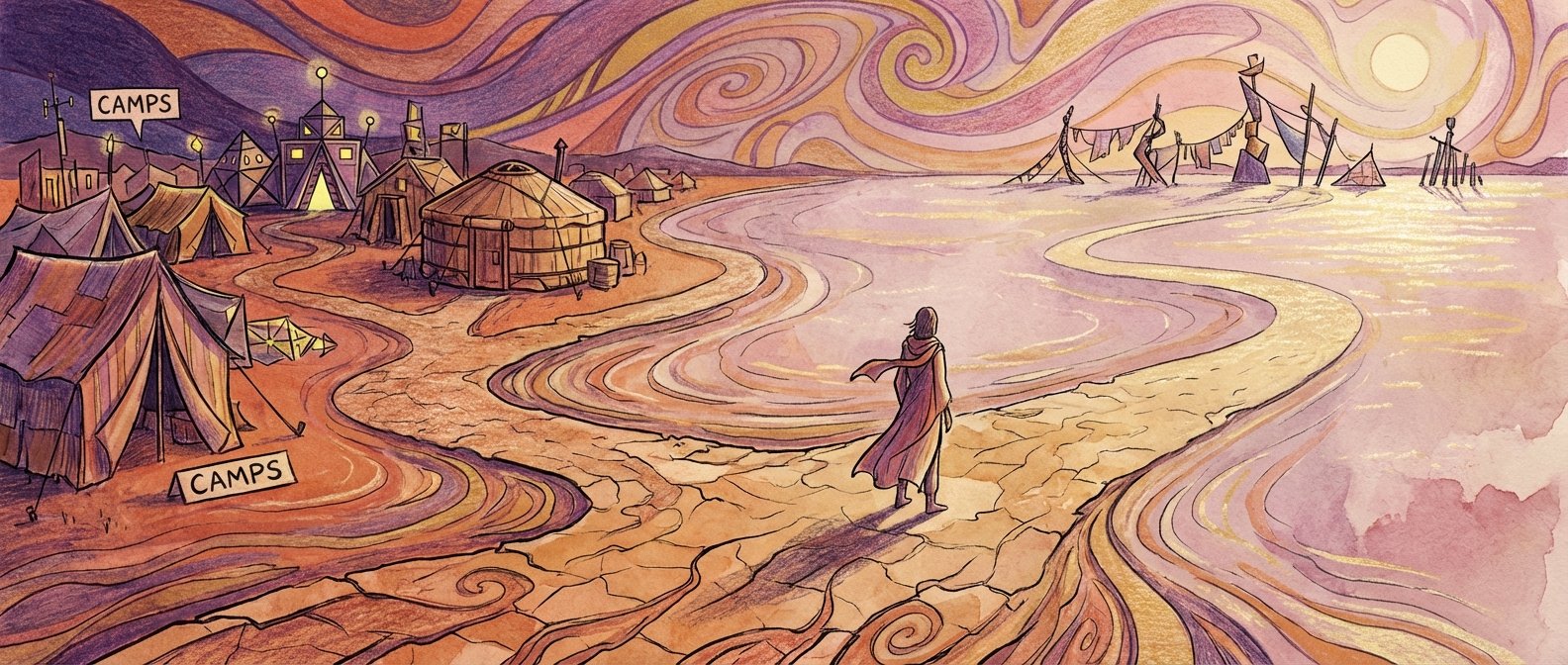
Always Walk Toward the Playa
When in doubt, when lost, when frustrated — move toward the open Playa.
This principle actually aggregates everything else: stop searching, stop planning, follow your desires, and just move toward the Playa. I started noticing a clear pattern: every time I couldn't find what I was looking for, or when things just weren't flowing, I'd get this sinking feeling that I was wasting my time, that nothing was happening. Whenever that happened, I reminded myself of the golden rule: just turn toward the Playa. The very second I turned my face toward the open desert and started moving, incredible things instantly began happening around me.
✦ Personal Story
Once, my night light broke. It was this rainbow light rig I used to illuminate myself in the dark. Being unlit at night on the Burn is really bad and actively dangerous. I had to fix it immediately, which meant I needed a soldering iron. In theory, soldering irons exist in big electrical camps. There are camps for absolutely everything out there: camps that give away free food, camps that hand out chewing gum, even my absolute favorite camp called "Clamp Camp" (where a guy literally brought hundreds of thousands of different types of clamps for any possible need!). Shoutout to the founder of Clamp Camp — you're awesome and you made my day.
So I opened the guidebook, found a technical camp that helps with electronics, and biked to their address. I get there — and there’s a sign saying they moved to a new location. I bike to the new address — and there's nothing there. Just empty dust, and nobody around has heard of them. I kept riding, searching, getting more frustrated, until I ended up deep inside the chaotic back-streets of some random camp.
I asked a guy passing by: "Hey man, do you know where the electronics camp is?" He looked at me and said, "Bro, you know how the Playa provides. It only provides if you believe you can find it. The moment you give up, it's over."
I said, "Yeah, I know." I took a breath, remembered my own rule, and made a decision: I'm just going to ride out of this maze and head straight toward the Playa. The second I turned my handlebars and started moving toward the open dust, something caught the corner of my eye. Just a few feet away, the guy I was just talking to had somehow magically appeared at that intersection. And right next to him, a woman was taping letters onto a wooden sign — it was the exact name of the camp I had been hunting for two hours! And right there, people were literally in that very second carrying soldering stations out into the street.
Everything clicked into place the absolute second I stopped forcing it, stopped searching, and simply started moving toward the Playa. I soldered my light, and it still works to this day.
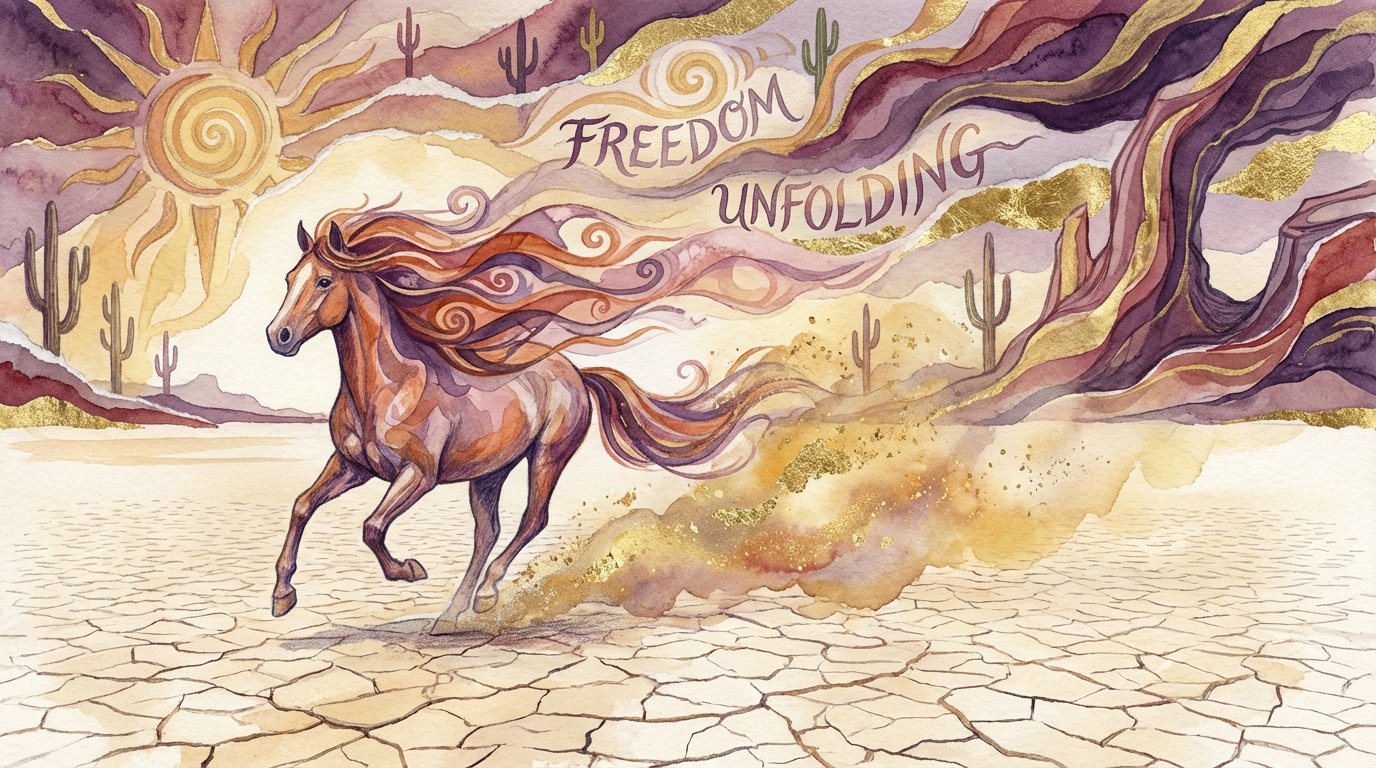
Trust the Pace
Trust the pace of the playa. Don't force events — follow your heart and desires.
Ukrainian boxing champion Oleksandr Usyk has a great phrase he uses in interviews: "Не гони коней" (Don't push the horses). It means don't rush the natural flow of things.
This principle is about dropping the hustle mentality. In the default world, we push. We make things happen. We force outcomes. We grind. On the playa, forcing things creates resistance. You push toward a specific experience and miss the organic one unfolding next to you.
Follow your desires, not your agenda. If your body says sleep, sleep — even if it's 10pm and "the best party is just starting." If your heart says sit with this stranger and talk for three hours, do it — even if your campmates are waiting. If something doesn't feel right, walk away. If something feels magnetic, follow it.
This is not about being passive. It's about being responsive. There's a huge difference between passively sitting in your tent and actively listening to what the moment is asking of you. Burning Man doesn't reward force. It rewards presence.
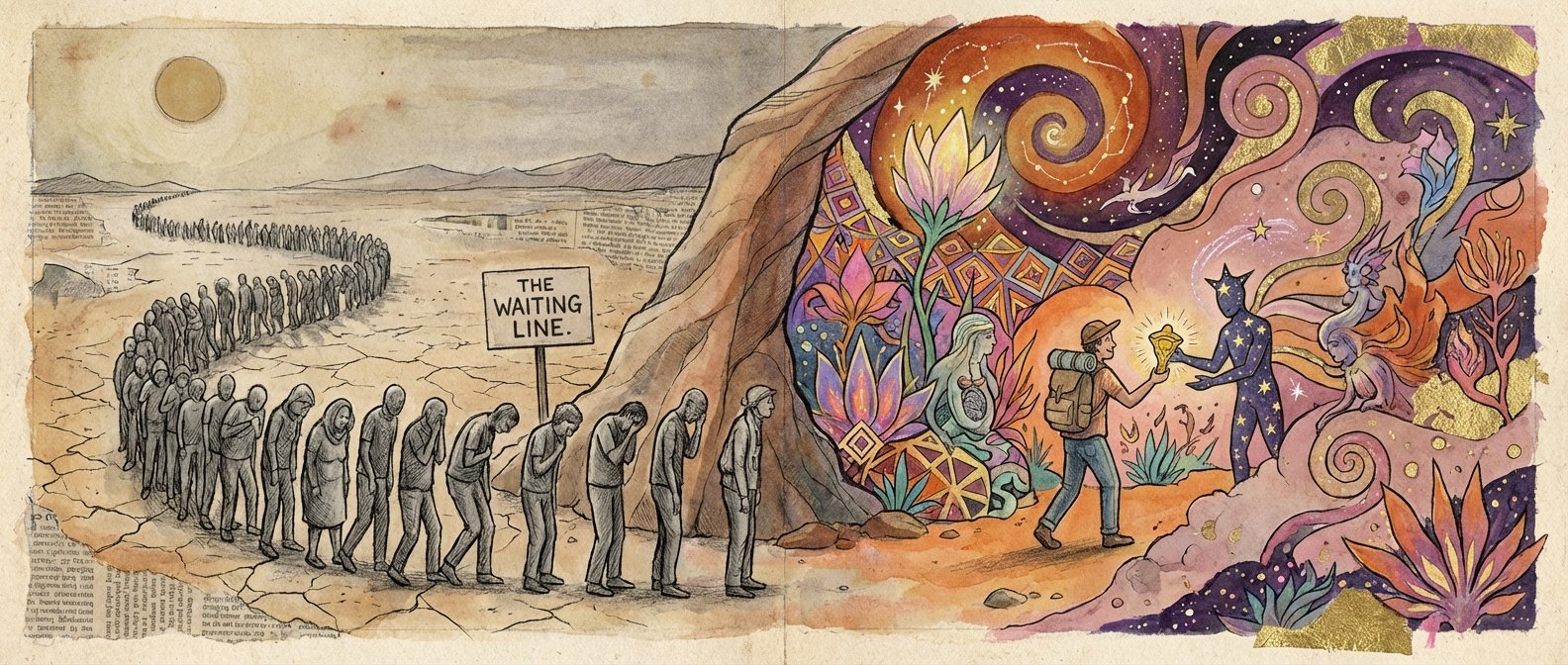
Skip the Line, Find the Magic
Don't stand in lines. Magical things don't happen in lines, unless it's your decision and desire.
This is Chapter 12's companion — the nuanced version.
Remember: these are my principles, I wrote them for myself. :) Most of the time, I see a line as a trap. For me, standing in line feels like forcing an event to happen, losing time, and it usually brings a negative, low-quality experience into my life. That's why I try to avoid them whenever possible.
Though, from the perspective of the camps hosting people — I can imagine the incredible emotions there. A camp wants to gift you an experience, and having a line is likely very rewarding for them (at least, that's how I feel it must be).
But occasionally, I try to turn a line into a valuable experience for myself. You choose to stand in it — not because you need the thing at the end, but because the line itself is where something is happening. Maybe you start talking to the person next to you. Maybe the wait forces you to slow down in a way you needed. Maybe standing still in a city of constant motion is its own radical act.
The key phrase is "your decision and desire." If you're in a line because FOMO dragged you there — because someone said this was the thing to do — get out. If you're in a line because something genuinely pulled you there and the waiting feels right — stay.
✦ Personal Story
Every time I stood in line, I felt it — I'm wasting time. I'm forcing the experience. The thing at the end of the line was usually something popular, something everyone said you "had to" do. But after waiting, the experience itself was always... fine. Never as good as the expectation. Maybe because of the inflated hype, maybe because I'd already spent my energy waiting instead of living.
But the magic? The real stuff? That happened when I showed up somewhere with no plan, no line, no expectation — and something was just happening at that exact moment. Those were the moments that made the burn. Not the ones I waited for. The ones that found me.
So this is personal, but I genuinely don't recommend standing in lines. The playa is too big and too alive for you to spend it waiting.
Walk When You Can
Walk on foot when you can.
You have a bike. You might even have access to an art car. Use them when you need to. But when you don't need to — when the distance is walkable and the weather is bearable — walk.
Walking is slower than biking (see Chapter 3), and that slowness is the point. On a bike, you're in transit. Walking, you're present. You notice more. You stop more easily. You're more approachable to other people — someone walking is an invitation to conversation in a way that someone on a bike isn't.
Walking is also how you feel the playa in your body. The crunch of the alkali under your boots. The wind changing direction. The temperature shift when you walk into the shadow of an art installation. These are small sensory experiences that your brain on a bike filters out.
One thing though — always carry a light at night. Cyclists can't see you in the dark, and people appear out of nowhere when you're riding. It's genuinely scary.
✦ Personal Story
I used to get frustrated at people walking without lights at night. They just appear out of nowhere when you're on a bike — terrifying.
But then one night, I went walking alone. And I turned my light off. On purpose.
There's something magnetic about moving through the playa in total darkness — invisible, dissolved into the art, the music, the people around you. Nobody notices you. You become part of the scenery. It's an incredibly intimate experience.
But I kept a flashlight in my hand. Every time I heard a bike approaching, I'd flick it on — just enough to light up my feet so they could see me. From a distance, I was invisible. Up close, I was safe.
So here's my recommendation: always carry a light. Walking dark is an amazing experience I genuinely recommend. But have that flashlight ready — because the people on bikes definitely cannot see you.
Pay a Visit to the Man and the Temple
Visit the Man and the Temple at least once during the day and once at night. These are completely different experiences. Make sure to bring a pen and write something on a note, or on the wall in the Temple.
The Man stands at the center of Black Rock City — you can see him from almost anywhere. He's the icon, the focal point, the thing that burns on Saturday night. During the day, he's a wooden structure on a platform, geometric and striking against the blue sky. At night, he's lit up with neon, a beacon drawing you across the playa like a lighthouse.
But the Temple is where the real weight lives.
The Temple is built new every year by a different artist or team. It's always stunning — intricate wooden lattice, soaring arches, delicate and temporary. And it's the emotional heart of Burning Man. People come here to grieve. To let go. To say goodbye. The walls are covered — floor to ceiling — with handwritten messages, photos, letters to dead loved ones, wedding rings, ultrasound pictures, military dog tags, divorce papers.
Visit the Temple during the day, when it's quiet, and read the walls. It will destroy you in the best way. Visit at night, when it's lit with candles and surrounded by silence, and it will destroy you differently. Bring a pen. Write something. It doesn't have to be for anyone else. It can be for you.
✦ Personal Story
The Man Burn on Saturday is a massive celebration — fireworks, art cars bumping bass, 70,000 people cheering like it's the start of a New Year. But the Temple Burn on Sunday is completely different. Even though people had told me about it, actually experiencing that absolute silence was astonishing.
Out of pure honor and respect, not a single camp plays music. For the first time in a week, the entire roaring playa goes completely, surreally quiet. You just hear the crackle of the fire and the weight of collective letting-go. Many people leave Sunday morning to avoid traffic or get back to work, but I highly recommend staying for the Temple. It is a profoundly separate experience.
I always leave things in the Temple that I want to let go of, along with letters I've written. Once, I brought a pair of sneakers I had worn every single day for a year and a half. I had been living as a nomad, traveling through 35 different countries. Because I couldn't carry much luggage, those sneakers went everywhere with me. They witnessed my entire transformation across different stages of my life.
But at some point, I realized I was ready to move on. I wanted a place to call my own. I wanted to stop wandering and put down roots. I intuitively felt that I needed to leave those nomad sneakers right there in the Temple. I let them burn. And shortly after that, I found my home base, stopped wandering, and settled into the city where I live today.
Sunrise at Trash Fence
Catch at least one sunrise and one sunset at Trash Fence.
The Trash Fence is the boundary of Burning Man — a 4-foot-high barrier that runs around the perimeter of the city to catch windblown debris. It's functional and ugly and completely mundane. And it has become one of the most sacred spots on the playa.
Every morning, dozens — sometimes hundreds — of people gather at the Trash Fence to watch the sunrise. They've been up all night. They've danced, wandered, cried, laughed, had conversations that rewired their brains. And now they're at the edge of the world, sitting in the dust, watching the sun come up over the Nevada desert.
Art cars park nearby, playing the last sets of the night — that golden-hour music, deep and warm, the sound of a city winding down. People are wrapped in fur coats and blankets. Some are dancing. Some are crying. Some are sitting in absolute silence. The light turns everything pink and gold, and the dust in the air makes it look like the sky is on fire.
The sunset at Trash Fence is different — more energized, more hopeful. The night ahead is full of possibility. People gather to watch the sun disappear behind the mountains, and then the playa lights up. The city transforms. It's like watching a creature wake up.
Go at least once for each. Go tired. Go alone or with someone you trust. Don't talk too much. Let the sky do the talking.
✦ Personal Story
The Trash Fence was built to catch trash. Wind on the playa is brutal — it rips things out of camps, off bikes, out of hands. Most of what you find on the ground wasn't thrown there — it was torn away by wind. The fence catches what the wind carries.
But it catches something else too.
I remember my first night on the playa. We were chasing the moon — and I still don't understand why, but that night it was impossibly huge, sitting right on the horizon as it rose. We just rode toward it on our bikes, hypnotized, knowing we'd never reach it.
And then we hit the Trash Fence.
That's when I understood. The Trash Fence isn't about trash. It's about people. It catches us — like fireflies — because without it, we'd ride straight into the endless Black Rock Desert and never come back. Burning Man feels huge, but it's a tiny speck in that desert.
I see three levels of irony in this — and I'll leave them right here without explanation.
Get Lost at Night
Get lost on the playa at night at least once. Meaning — you alone, by yourself, lost on the playa. At least once at night you need to do this, for the entire night.
This is the principle that scares people. Good.
Here's what it means: one night during the burn, go out alone. No campmates. No plan. No map. No destination. Just walk (or ride) into the playa after dark and see what happens.
The playa at night is a completely different world. The art installations transform — structures that were metal skeletons during the day become glowing, pulsing, living things at night. Art cars cruise by like ships in the dark, trailing music and light. The deep playa becomes an alien landscape of LED sculptures floating in blackness.
And you'll get lost. Not dangerously lost — the city lights are always visible from the playa, and the Man (when he's still standing) is a constant beacon. But psychologically, experientially lost. You won't know what time it is. You won't know which direction you came from. You'll have to surrender your need for control and let the night carry you.
Some of the most profound Burning Man experiences happen to people alone at 4am in deep playa. The veil between your daily self and something deeper gets thin out there. It's just you and the desert and the stars and whatever you've been avoiding. It finds you when you're alone. That's why it has to be solo.
Bring warm layers. Bring water. Wear lights so art cars can see you (this is a safety requirement). And then just... go.
✦ Personal Story
I won't share the details of what happened on those nights. Some things belong to the playa and stay there.
But here's what I will say: we made it a rule — with friends, even with my girlfriend — that at least one night during the burn, we split up. Everyone goes solo. Gets lost on purpose.
Both times I did this, the experience was deeply, profoundly insightful. Without exaggeration — those nights helped me work through personal blockers and inner conflicts that I'd been carrying for a long time. Things I couldn't resolve in therapy, in conversations, in my normal life. The playa at 3am, alone, has a way of making things clear.
I can't explain how it works. I just know it does.
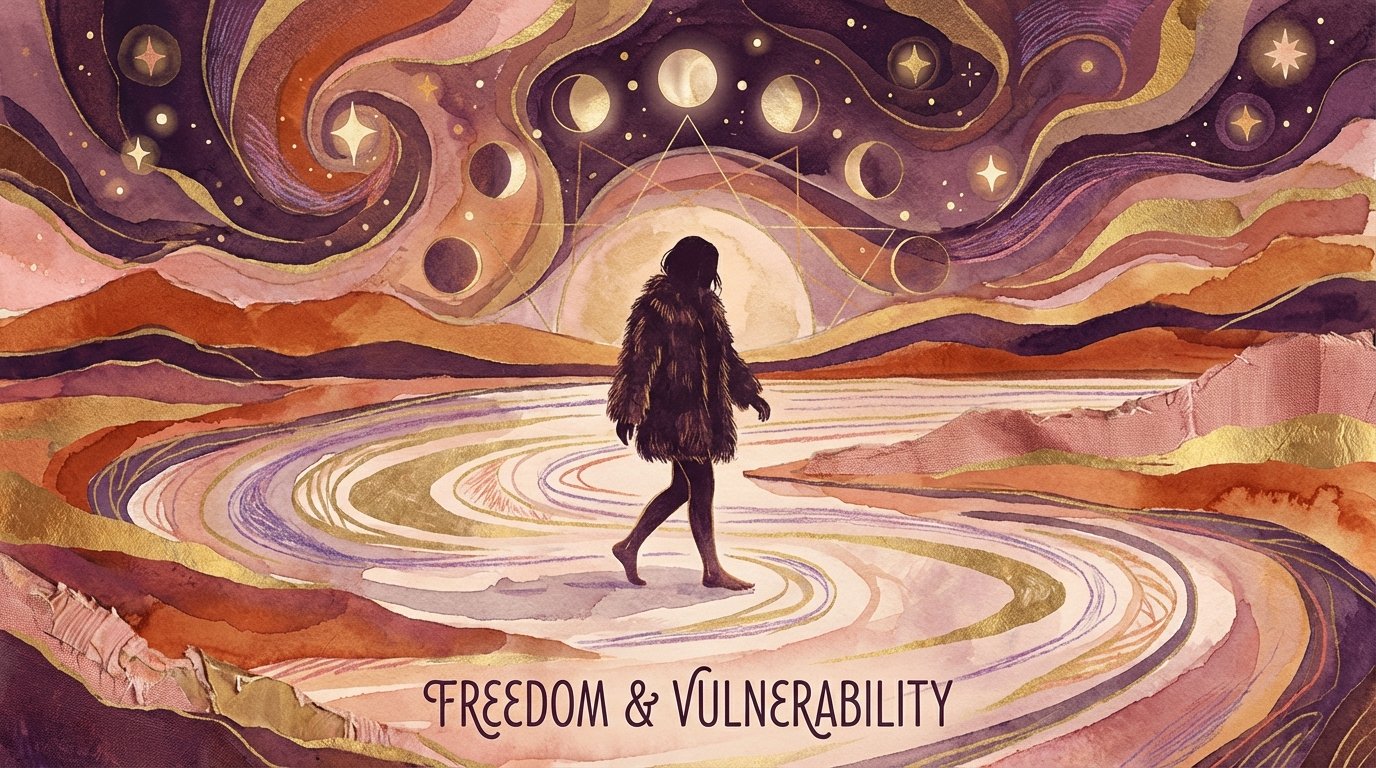
Go Naked and Barefoot
Go naked and barefoot at least once, you can wear a fur coat (in deep playa) at night.
Yes, actually naked. At least once.
Burning Man is one of the very few places on earth where nudity is completely normal and completely unremarkable. Nobody stares. Nobody cares. There's no sexual charge to it (or there doesn't have to be). Bodies of every shape, size, age, and state are just... there. It's radical normalcy.
Going naked is about shedding armor. In the default world, your clothes are your identity. Your brand. Your status signal. On the playa, when you strip all of that off, you're just a human in the desert. It's terrifying for about ten minutes, and then it's the most freeing thing you've ever done.
Barefoot is a different experience. The playa surface — alkali dust over a hard-packed lake bed — is surprisingly smooth during the day (unless it's just rained, in which case it's clay-like mud that will eat your shoes). Walking barefoot connects you to the ground. You feel the temperature change as the day shifts. You feel the texture of the desert. It makes you slow down (see Chapter 3).
At night in deep playa, the temperature drops hard — sometimes to near freezing. That's when the fur coat comes in. There's something primal and hilarious about being naked under a massive fur coat in the middle of a desert at 3am, standing next to a 40-foot metal sculpture shooting fire. That contrast — the vulnerability of skin and the warmth of fur — is pure Burning Man.
A few safety notes on barefoot: On the open playa, walking barefoot is generally safe — last year the surface was soft and puffy, almost pleasant (though bikes struggled). But in the city, be careful. There are tent stakes, rebar, sharp edges everywhere. You can seriously hurt your feet.
And if it rains — avoid puddles in the city when barefoot. Generators run everywhere, and there's a non-zero chance that a wire from a generator runs through a puddle. You don't want to find out the hard way. On the playa itself, rain barefoot is fine — just watch for puddles near camps.
✦ Personal Story
You know those public speaking tips where they say "wear something unusual to work and realize nobody actually cares how you look"? The idea is that people respond to what you say, not what you wear — and that realization builds confidence.
I decided to take that to the extreme. If wearing a weird outfit builds confidence, what would walking around completely naked do?
I've had stage fright since childhood. Every public speaking moment was terrifying — even after doing it many times. So on the playa, I went naked. Walked through the city, through crowds, through camps. And something shifted.
After that, I became significantly less afraid of the stage. Public speaking got easier. Not because being naked on the playa has anything to do with giving a talk — but because once you've been that exposed, that vulnerable, in front of thousands of people, standing on a stage in a suit feels like nothing.
That was my reason. Yours might be completely different. But the principle is the same: do the thing that scares you, and the other scary things get smaller.
Climb on Things
This one is beautifully simple.
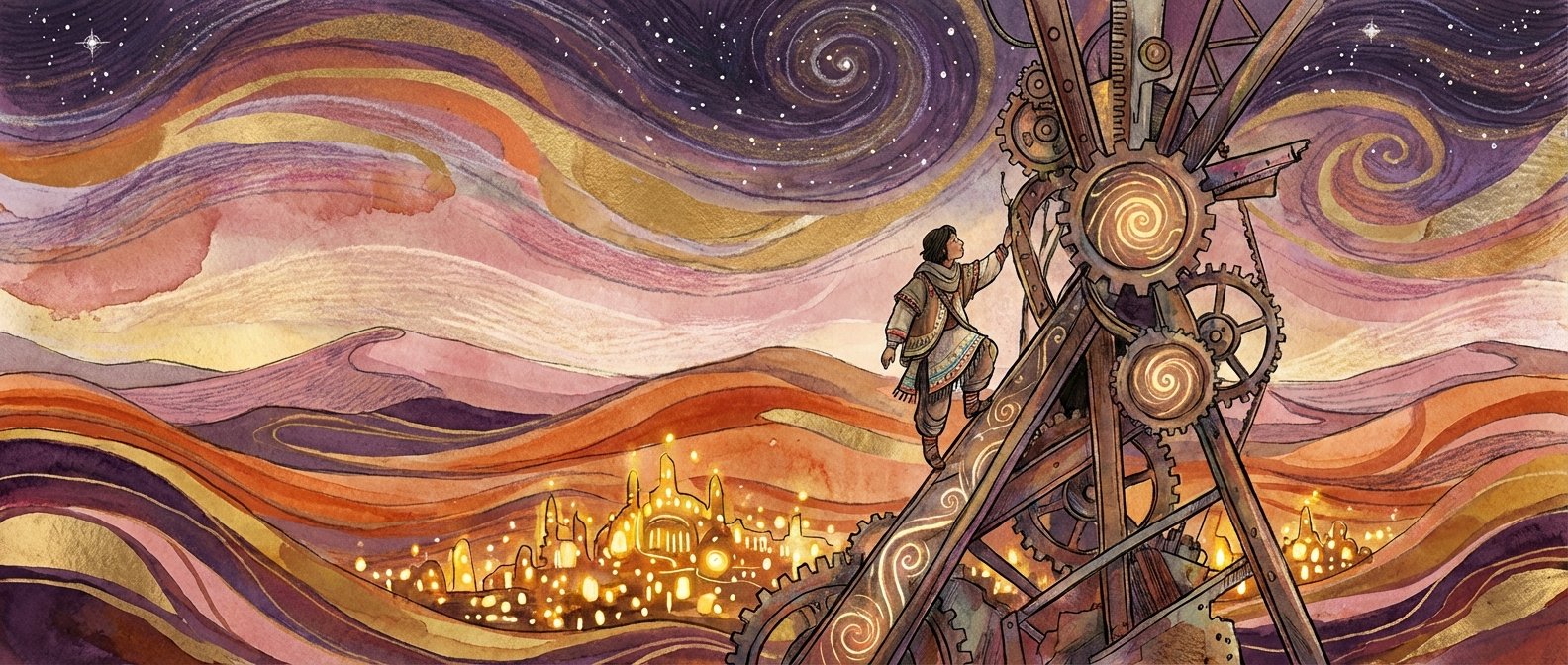
Burning Man art is interactive. Unlike a museum where you stand three feet away behind a velvet rope, playa art invites you to touch it, climb it, sit on it, sleep inside it. Many installations are specifically designed to be climbed — towers, sculptures, structures with ladders and platforms and nests at the top.
Climb them.
Get up high and look at the city from above. At night, from the top of a tall structure, Black Rock City looks like a circuit board — a glowing, pulsing, living machine in the middle of absolute darkness. During the day, you can see the curve of the city, the Man in the center, the Temple in the distance, the mountains on the horizon.
✦ Personal Story
I have always loved climbing. When I was younger, I did rock climbing and mountaineering as a sport — I was on teams and competed in tournaments — so scaling things has always been in my nature. But as you grow up, society constantly tells you it's weird, dangerous, or just "not cool" for an adult to be climbing randomly. People look at you skeptically.
But on the Playa, nobody cares. The unofficial motto is "Safety Third." Nobody is going to give you weird looks for scaling a giant structure. And when you do, you unlock your inner child. You start exploring the world again through physical interaction, changing your perspective literally and mentally.
There's another piece of advice I highly recommend: walk away from the center at night, head deep out toward the Trash Fence, and just look back at the city from a distance. I am absolutely mesmerized by that chaos. I love stepping out of the center of it, standing on the edge, and just watching the visual madness unfold from afar. It's an incredible way to see the sheer scale of what we've built.
Playa Gifts Are Real
Sometimes the playa may have gifts for you. Yes, actual gifts — not MOOP lying on the ground. But don't steal other people's things. You'll feel when something is not for you and when it is. If it's for you — take it. If it belongs to someone else — don't. Be conscious about this.
This one sounds mystical until it happens to you.
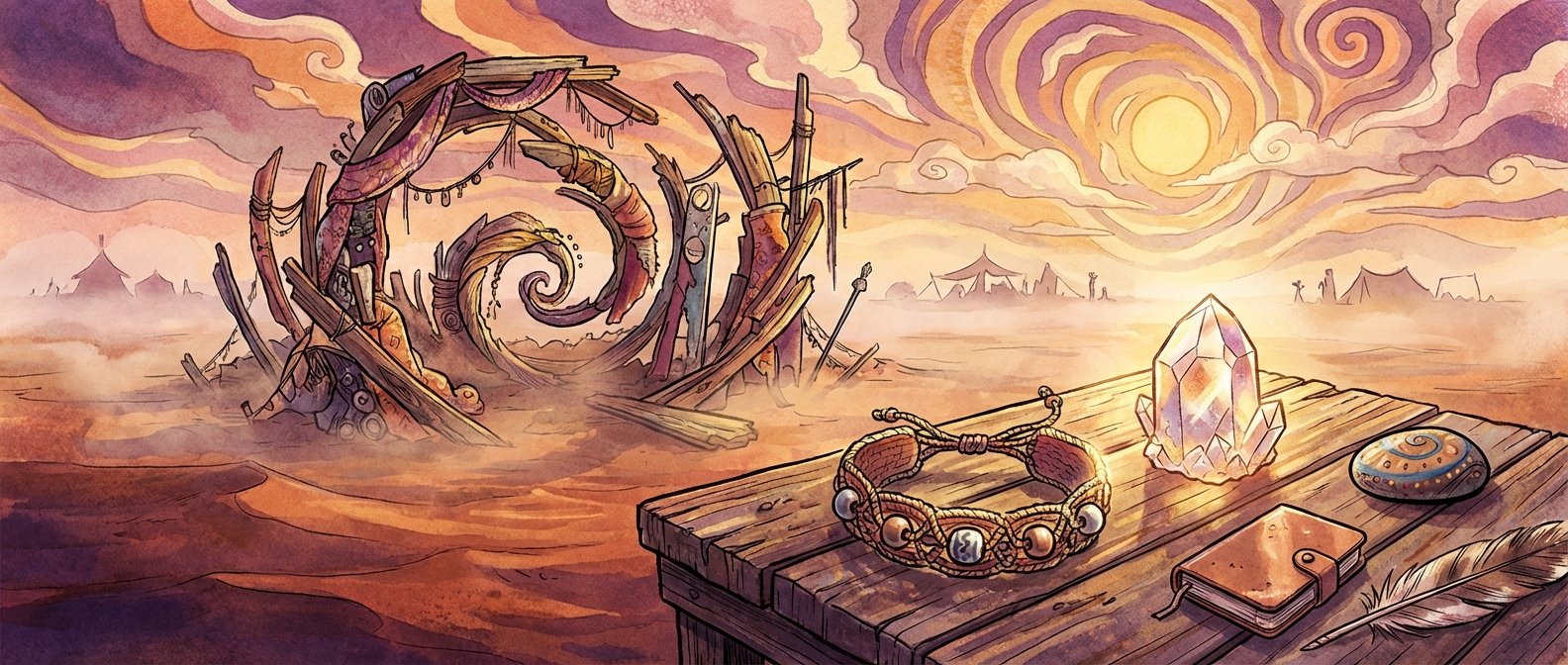
You'll be walking through deep playa and find a bracelet sitting on top of an art installation. Not lost — placed. Waiting. You'll feel a pull toward it, a sense that it was put there for you. This is different from finding someone's dropped water bottle or a forgotten scarf. There's an intention to playa gifts. They feel deliberate.
Burning Man's gift economy runs on the principle of unconditional giving. People leave things on purpose — small art pieces, poems, trinkets, meaningful objects. Some are placed at specific art installations. Some are tucked into the Temple walls. Some are just... there.
The flip side is equally important: don't take things that aren't for you. If something is clearly someone's property — their camp gear, their bike accessories, their costume piece — leave it alone. The distinction between a gift and someone else's stuff is usually obvious. Trust your gut. If there's even a moment of "this might belong to someone," it does.
This principle is really about developing sensitivity. Burning Man will sharpen your intuition if you let it. You'll start to feel the difference between things that are meant for you and things that aren't — not just objects, but conversations, experiences, connections. That skill transfers to the rest of your life.
✦ Personal Story
A friend once lost his fur coat on the playa. It was freezing, a dust storm was blowing, visibility near zero. They stopped by an art car to wait it out — and right there, lying on the ground, was a fur coat. He put it on. The playa gave him exactly what he needed.
My own gift was different.
I found a wooden stroller — hand-carved, sitting on the playa. I don't remember exactly what was written on it — maybe something about infants, maybe something else entirely. But what I felt was this: it represented children who can't walk, can't explore the world on their own. The idea — as I understood it — was to take the stroller somewhere on the playa and let it travel for those who can't. There was a camera on it, recording everything.
I imagined children in hospitals watching these clips — seeing the playa through this stroller's journey. And it hit me. I'm lucky — healthy body, good genetics — but I've carried a fear of disability since childhood. Pushing that stroller, I thought: I could actually do something when I get back. Raise awareness, raise money for prosthetics, visit a hospital — just do something real.
I decided right there that I would.
And the moment I made that decision — literally on the path we were walking — I saw a small wooden amulet lying on the ground. Brown, on a string. I picked it up and knew: this was the playa's gift to me. Not MOOP. A reminder. A seal on the promise I'd just made.
That amulet hangs in my apartment to this day. It reminds me to keep that promise. And I have — those who follow me know I've done several initiatives for people with disabilities since.
That's the difference between MOOP and a gift. You'll feel it when it happens to you.
Write Everything Down
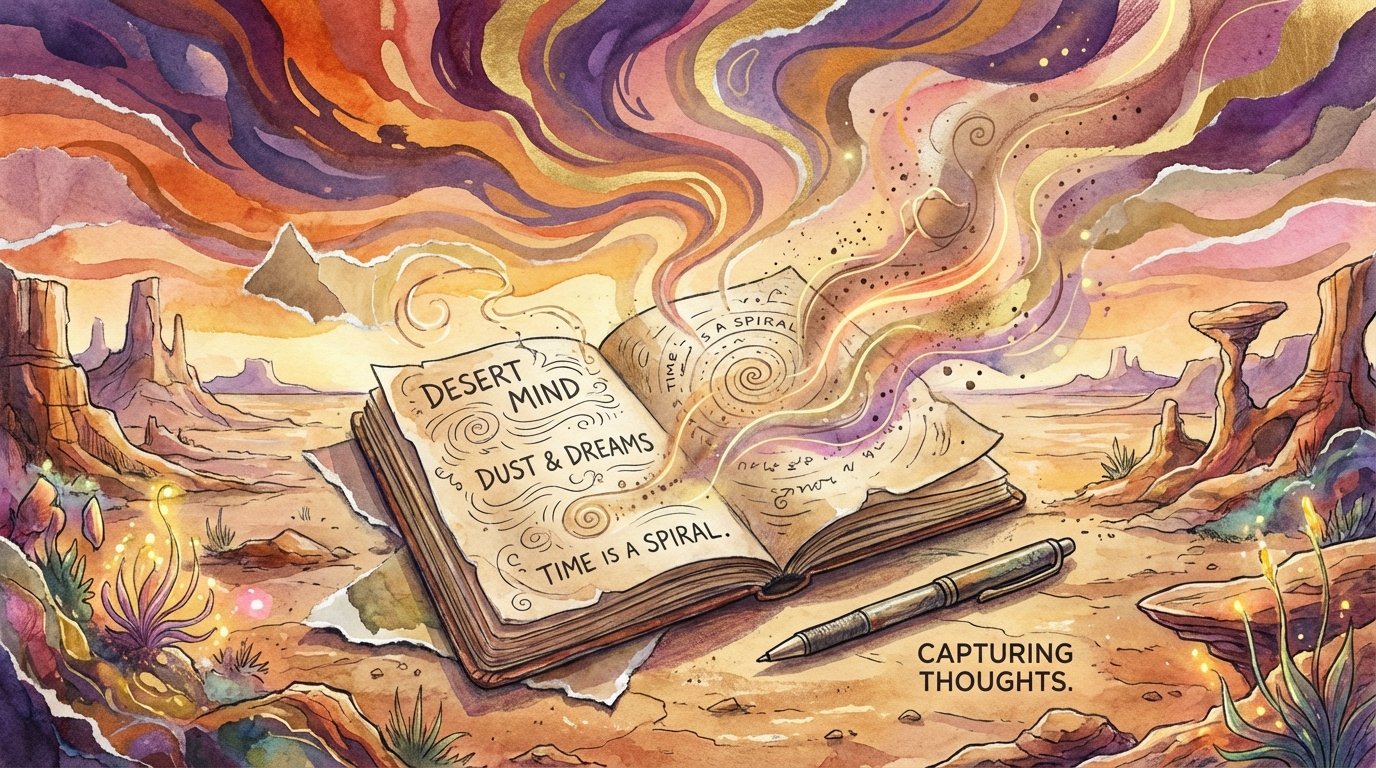
Make a sheet or a notebook where you'll write down your thoughts and insights. Everything gets forgotten super quickly as soon as you leave, but there are important things there that you'll discover.
This is possibly the most practical principle in this entire book, and the one most people ignore.
Burning Man compresses months of emotional and psychological experience into seven days. You'll have realizations, epiphanies, breakthroughs. You'll understand something about yourself or your life with sudden, crystalline clarity. You'll think "there is no way I'll forget this."
You will forget this. Within 48 hours of leaving the playa, the dust settles (literally and figuratively) and the default world floods back in. The clarity fades. The insight that felt earth-shattering at 3am in deep playa becomes vague and gauzy by the time you're back in your apartment.
Write it down. Carry a small notebook and a pen everywhere. When something hits you — a thought, a feeling, a realization, a conversation, even just a word — write it down immediately. Don't edit. Don't analyze. Just capture.
When you read it later — days, weeks, months, years later — you'll find things in there that still apply. Insights that your playa self was trying to send to your future self. Some will be gibberish. Some will be profound. All of it is data from a version of you that was operating without the usual filters.
The notebook is your most important piece of equipment. More important than your bike, your goggles, your lights. Bring it.
✦ Personal Story
During my first Burn, as I mentioned, I didn't use my phone. But I also didn't bring a pen or a notebook. When you meet incredible people out there, you naturally want to exchange contacts or Instagram handles, but without a phone or paper, I had absolutely no way to write them down. That was the first problem. The second problem was that brilliant thoughts and realizations would strike me out of nowhere, and almost instantly evaporate from my mind.
For my second Burn, I learned my lesson. I carried a few sheets of paper and a pen everywhere I went. In fact, that's exactly how many of these 25 principles were born — I wrote them down the very second I experienced them so I wouldn't forget.
My biggest regret is that I didn't write down all the crazy, magical stories as they were happening. At the time, you think: "There's absolutely no way I will ever forget this." But you do. I could probably tell three times as many stories for every single principle in this book if I had just written them down. Don't make my mistake. Write it down.
Follow the 10 Principles
Follow the 10 principles of Burning Man, explore their meaning. There are several levels of depth.
The 10 Principles were written by Burning Man co-founder Larry Harvey in 2004. They weren't meant to be rules — they were an attempt to describe what was already happening organically in the desert. They are:
- Radical Inclusion — Anyone may be part of Burning Man.
- Gifting — The value of a gift is unconditional.
- Decommodification — No commerce, no brands, no transactions.
- Radical Self-reliance — You are responsible for yourself.
- Radical Self-expression — Express yourself freely.
- Communal Effort — We build this together.
- Civic Responsibility — Take care of each other and the community.
- Leaving No Trace — Clean up everything.
- Participation — No spectators. Everyone contributes.
- Immediacy — Be here now.
Take "Gifting." On the surface: give things to people, don't expect anything back. Simple. One level deeper: realize that commodifying everything — putting a price on attention, time, love — is the source of most human suffering. Another level deeper: understand that you yourself are a gift, and your presence — not your productivity — is what has value.
Take "Radical Self-reliance." On the surface: bring enough water, don't be a burden. One level deeper: stop expecting other people to fix your problems. Another level deeper: realize that self-reliance and community aren't opposites — you have to be whole within yourself before you can truly give to others.
These principles work in layers — each one contains another meaning underneath. Every burn, you understand them a little differently. A five-year veteran reads them completely differently than a first-timer. That's by design.
Read them before you go. Then live them on the playa. Then read them again when you get home.
✦ Personal Story
Take Gifting, for example. Your first instinct as a newcomer is to bring physical gifts — stickers, trinkets, things to hand out. I brought three watermelons to my first burn. Because you're supposed to bring gifts, right?
But gifting isn't about objects. It's about experience.
Our camp's gift was the art car — we gifted music. Anyone who danced was receiving our gift. When I worked shifts on that art car, I was part of it. By my second burn, I understood: the gift is you. Your smile, your help, your presence. Show up for someone. That's already a gift.
Still, I wanted to share something physical too. For my second burn, I brought Snickers and Mars bars — my absolute favorite chocolate snacks. I just wanted to share my favorite sweets with people. As it turns out, there are tons of little mailboxes and hidden boxes all over the Playa that people use to pass gifts and messages to one another. I ended up leaving some of my snacks in the ones that wouldn't melt in the sun. I really hope someone got lucky at night and found my un-melted Mars bars!
And here's something important: gifting is not a transaction. If someone gives you something — don't immediately scramble to give something back. Don't steal their experience of giving. Let them give. Receive it fully. The moment you turn it into an exchange, it stops being a gift and becomes commerce.
Two Weeks of Grace
Don't make important decisions for two weeks after Burning Man.
This is the final principle, and it might be the most important one for your life back home.
Burning Man will change you. Not in a bumper-sticker way — in a real, structural way. You'll come back seeing things differently. Your job might feel meaningless. Your relationship might feel hollow. Your city might feel suffocating. Or the opposite — you might come back feeling deeply in love with your life, overflowing with gratitude and ambition.
Both states are real. Both are temporary.
The playa strips you down and rebuilds you in seven days, and your psyche needs time to integrate that experience. The person making decisions in the first week after the burn is not the person who went in. They're not the person who'll exist in a month either. They're in transition — raw, unfiltered, emotionally volatile.
Don't quit your job. Don't break up with your partner. Don't propose. Don't buy a one-way ticket to Bali. Don't invest in your campmate's startup. Don't get a tattoo of the Man (well — maybe). Don't make any decision that will significantly alter the course of your life.
Wait two weeks. Let the dust — literal and emotional — settle. Journal. Talk to people who've burned before. Let your default-world self and your playa self negotiate a truce. The decisions that still feel right after two weeks? Those are real. The ones that fade? Those were the dust talking.
✦ Personal Story
Olexi warned me about the two-week rule before my first Burn, and I took it very seriously. By Friday of my first year, I was so utterly overwhelmed—emotionally and mentally—that I caught myself thinking: "I'm not going to say 'never again,' but I really don't feel like I'll ever come back to Burning Man." It was just too much to process.
Then I got back to civilization. By Monday or Tuesday, my brain was already negotiating: "Well, maybe I'll go." By the end of the first week, I felt completely grounded again and thought, "Okay, the shock is gone, this 'two weeks' rule is nonsense." But by week two, my perspective shifted entirely once again. I was sitting there thinking, "How could I have possibly thought I wasn't going back? Of course I'm going back!" It took exactly that two-to-three-week window for my nervous system to fully process the shock and for my true feelings to settle.
Because of this, after my second Burn, I approached things differently. On the drive home, I had already made several major life decisions. I knew exactly what I wanted to do. But I refused to execute them immediately. Instead, I wrote them all down in my notebook and made a promise to myself: I will wait exactly two weeks. If these decisions still feel just as true and important after 14 days in the default world, then I will act on them.
And that’s exactly what happened. The dust settled, the ideas remained, and three weeks later, I started executing them—knowing for sure it wasn't just the Playa talking, but my actual desires.
And that's it — the 25 principles. If you've read this far, thank you. You now have the foundational rules of survival, connection, and letting go.
But there is one final piece. The last, and honestly, the most important part of this entire experience: Integration.
(After this, I promise, it's just a quick FAQ and a bit about me, and then we're done. Hang in there.)
Integration
Integrate what you learn, or it was all for nothing.
Burning Man will crack you open. It will show you things about yourself, about connection, about what matters — things that feel obvious and earth-shattering at the same time. And then you'll drive out through the Gate, hit the highway, turn your phone on, and the default world will start flooding back in.
This is the most dangerous moment of the entire experience.
Not dangerous like dehydration or whiteouts. Dangerous because everything you just learned — every insight, every breakthrough, every principle in this book — is about to get buried under emails, deadlines, traffic, and routine. The dust washes off. The tan fades. And six weeks later, you're back to walking in straight lines and standing in lines and pushing the horses and staring at your phone.
Integration is the practice of deliberately, consciously bringing playa lessons into your default world life.
Athletes say the game is 10% of the work. Training, recovery, and preparation are the other 90%. Burning Man works the same way — the burn is the opening. What you do after is the actual transformation.
Here's what integration looks like in practice:
The first two weeks — You're raw. Everything is too bright, too loud, too fast, too commercial. You might cry in a grocery store. You might feel furious at how wasteful everything is. You might want to quit your job and move to the desert. This is normal. This is Chapter 25. Don't make big decisions. Just feel it.
Weeks 2-4 — The intensity fades. This is where most people lose the thread. The insights start to feel distant, like a dream you can't quite remember. This is when you read your notebook (Chapter 23). This is when you call your campmates. This is when you actively choose to remember.
Month 2-3 — Now the real work begins. Take one principle — just one — and implement it in your life. Maybe it's "don't walk in a straight line" — you start taking different routes, saying yes to unexpected things. Maybe it's "don't attach yourself to time" — you leave your phone in another room on Sundays. Maybe it's "just ask" — you start asking for help instead of suffering in silence.
The rest of your life — Integration never ends. Every burn adds new layers. Every year, you understand the principles differently. You don't become a "burner" in one week. You become one over years of practice — on and off the playa.
The P.S. of this book says "the whole world is the playa." That's not a metaphor. It's a practice. And integration is how you practice it.
The Survival Guide (FAQ & Logistics)
I wanted to stop at the 25 principles. That was the original idea — just the rules, nothing else. But I know that if you're a newcomer, you have practical questions. The kind that keep you up at night before your first burn.
So here is the short, honest guide to the logistics of Black Rock City. The 25 principles are the soul of the book. What follows is the survival manual.
FAQ: The Burning Questions
Q: Do I have to do drugs? Is everyone just high 24/7?
A: This is probably the biggest stereotype about Burning Man, and I completely disagree with it. I know plenty of people — close friends — who go to Burning Man entirely sober. They don’t even drink alcohol. And they have the time of their lives.
Burning Man is a mirror: you will find exactly what you expect to find. If you go in heavily prejudiced, obsessing over the idea that everyone is on drugs, then all you will see are people on drugs. But if you go with an open mind, simply looking to connect with clear-headed people, you will suddenly find yourself surrounded by sober, incredible humans. The playa gives you the experience you tune yourself into.
And there is a hard, practical reality people forget: Burning Man takes place on federal land in the state of Nevada. Drugs are illegal there. Period. Even marijuana is illegal on federal land. It is not a lawless zone. If the cops see you smoking weed in the open on the playa, you will be arrested.
You do not need substances to experience the magic of Burning Man. The playa itself is the trip.
Q: What is the real budget for Burning Man?
A: It depends heavily on where you are starting from. If you live in Europe, your budget immediately takes a hit from flights, pre- and post-burn hotels, and the massive logistical headache of storing your gear in the US. If you live in California, it's significantly easier and cheaper.
A ticket itself is around $500–$600 plus taxes. After that, the playa scales from "literally zero" to "luxury hotel prices." You can theoretically survive the week for free once you're inside. You can stay in public shelter camps, find free food giveaways, and get water from neighbors. On the other extreme, you can fly in on a private charter, have a fully stocked luxury RV delivered, buy top-tier electric bikes, and easily blow past $100,000 for the experience.
But realistically? For a standard, relatively comfortable first burn without extreme survivalism or crazy luxury, expect to spend at least $3,000 to $5,000 in total for your first year. The good news is that the second year is much cheaper. You’ll re-use almost everything you bought — lights, goggles, hydration packs, clothes. For my second burn, my main expenses were just the RV rental and gas.
As I was researching for this book, I looked at the Black Rock City Census data. In 2024, over 50% of attendees had a personal income of more than $100,000 (and by 2026, it's likely approaching 60%). Meanwhile, the percentage of burners making under $50,000 drops every single year. It's a stark reflection of economic shifts. Either the core burners are just getting older and making more money in their careers, or — more likely — the rising baseline cost of attending is slowly pricing out lower-income participants. The reality is that Burning Man has become an expensive endeavor.
Q: What happens if it rains? The news made it look like a disaster.
A: There is a distorted image of rain on the playa, mostly driven by the media panic of 2023. The myth is that if it rains, the burn stops: you can't ride bikes, everything is muddy, the fun ends, and everyone just sits in their tents waiting to be rescued.
That panic only happened because the rain hit at the very end of the week. People were exhausted, they just wanted to go home, and they tried to drive their cars through wet clay.
But rain on the playa is actually amazing. If it happens early in the week, it’s a blessing — it packs the dust down. Yes, you can't ride your bike in the mud. But walking through it? It's incredible. The parties don't stop. The art is still there. People don't disappear. You just put on boots and keep exploring.
Even if you hate the mud, it can be special. One of my friends was absolutely terrified of the rain, thinking it would completely ruin the party. But later she told me that sitting in that RV with her friends during the storm — playing board games, eating snacks, and talking — was actually one of the coolest experiences of her whole burn. Don't fear the rain. Embrace it.
Q: Do I need to spend thousands of dollars on crazy costumes?
A: There are endless guides online about Burning Man fashion, but I’ll keep it simple: for your first burn, do not stress about it.
Unless you naturally have a burning desire to express yourself through wild, elaborate outfits (in which case, you don’t need my advice anyway), keep it simple. For my first burn, I went to a local thrift store that sold authentic national clothing. I bought some desert pants, Peruvian shirts, and a few loose layers. I ordered the most basic faux-fur coat off Amazon with next-day delivery. That was it.
By my second burn, I understood my personal playa style better and put a bit more thought into it, but still kept the budget minimal. Some people spend thousands of dollars and change outfits three times a day. I prefer practicality. I have a style I like, so I’ll just bring three pairs of identical pants and cycle through them.
If you are seriously stressing out about what to wear — stop. There are people walking around Burning Man in plain jeans, sneakers, and a t-shirt, having the time of their lives. Nobody cares. Wear what makes you comfortable, bring good socks, and make sure you have a warm coat for the night. The rest is optional.
Camps, Housing & Gear
What Are Camps?
Black Rock City isn't built by Burning Man the organization — it's built by camps. They're groups of people who come together to create something — a bar, a workshop, a sound stage, a spa, a breakfast joint. Theme Camps provide interactive experiences. Sound Camps (like Robot Heart or Mayan Warrior) host DJs with massive sound systems. Joining a camp is a commitment: you'll be expected to contribute labor, money, or both (dues are typically $200–$1,000+, though big camps can easily go for $3,000, $6,000, or even $10,000+ a person). Or, you can go campless (open camping), which is harder logistically but gives you total freedom.
A Note for Virgins (First-Timers): I'd kinda recommend going with a big, established camp for your first Burn. Burning Man is a stressful, overwhelming environment. A big camp usually has well-thought-out logistics, built-in infrastructure, and food already organized. This minimizes stress so your first Burn can pass much more comfortably. Plus, having many people from your camp around who can help you navigate the chaos is a massive advantage.
However, big camps vary wildly. You must do your research before committing. Ask for reviews from past participants. Ask the camp leaders directly what they are planning for this year and what exactly will be expected of you. Talk to people outside the camp for objective reviews. This is the only way to understand what awaits you and whether their vibe is truly to your liking.
And remember one crucial thing: you are not shopping for a hotel. You don't just pick a camp and say "I want to go here." Getting into a good camp is your first real challenge. The camp interviews you to see if you are a good fit, not the other way around. They choose who they want to bring. So think carefully about what value you bring, why you specifically should go with them, and how you will add to their community. Don't be arrogant. Be a human first.
Where should I sleep? RV or Tent?
I'll be honest: it’s hard for me to give unbiased advice here because both times I went, I stayed in an RV.
If you book an RV very early and split the cost between four people, it actually becomes quite manageable. People will try to scare you about RVs: "Don't use the toilet, don't use the AC, if the generator breaks you're screwed!" And yes, if it breaks in the desert, it’s a nightmare. But mine never broke. I used the AC, the toilet, and especially the shower without any issues. For me, having a private bathroom is a massive mental comfort.
A hack for RVs: You’ll hear horror stories about the holding tanks filling up. Because of this, many people rent RVs and still refuse to use their own toilets for a week. What they don't tell you is that there are trucks driving around the city specifically to pump out your sewage and refill your fresh water. It costs about $90–$100. You just flag them down, pay them, and you’re good to go. I empty and refill my tanks twice during the week. Use your toilet.
Even if you go with a standard camping tent on a super low budget — honestly, just making it to the playa is already a holiday, an incredible achievement. The experience you'll get — raw, close to the dust, unpredictable — might be exactly the experience you need. What feels like "suffering" to one person is pure freedom to another. If a tent is what gets you to Black Rock City, do it. Just make absolutely sure it’s set up under a proper shade structure, or you will literally bake alive after 9 AM. If you have a slightly bigger budget but want to stay grounded, use a Shiftpod (a specialized insulated shelter) and attach a portable AC to it.
Ultimately, it comes down to budget and what kind of adventure you want. I've seen people sleep in converted school buses, Mercedes Sprinter vans, or even just their cars — and they had a fantastic time. If you make it there, the magic will happen regardless of where you sleep.
Food and water — how much do I actually need?
The golden rule for water: 1.5 gallons (6 liters) per person per day minimum. Figure out what you think you need, and double it. You will drink constantly.
Food depends entirely on how you go. If you go with a big placed camp, many provide meals. During my first burn, our camp had a full kitchen with breakfast, lunch, and dinner (though I usually only ate twice a day because the adrenaline suppresses your appetite). But be careful and ask questions — some camps say "meals included," and that turns out to be one cold sandwich a day.
If you go independently with a small group (like I did my second year), you bring your own. We brought a lot of food, and honestly, we took most of it back home. You don't eat as much as you think you will.
My biggest advice on food: bring treats. The playa strips away your usual comforts. Eating a Snickers bar on a Friday afternoon out there feels like a religious experience. Better yet, stash some ice cream bars deep in your RV freezer and hand them out to strangers on Saturday. It will be the greatest gift they receive all week, and they will never forget you.
What else do I bring? (The Absolute Must-Haves)
- Dust protection — goggles (not sunglasses — actual sealed goggles) and a face covering (bandana, respirator). Whiteouts happen.
- Lighting — you MUST be lit at night. Bikes, bodies, everything. Art cars can't see you if you're not lit. Bring extras.
- Warm layers — the desert drops to near-freezing at night. The swing can be 50°F+ between day and night.
- Bike — cheap single-speed with fat tires. Don't bring an expensive mountain bike; the dust will destroy it.
- Your own cup — nobody has disposable cups (Leave No Trace). Clip a mug to your belt for drinks at camps.
- Trash bags — you pack out every wrapper, every can, every scrap. No exceptions.
- A Note for Women: specifically search for "Burning Man packing list for women." Generic lists miss important hygiene essentials and practical tips for dealing with the playa environment.
Language & Principles
The Playa Glossary
- Art Car (Mutant Vehicle)
- A vehicle modified into a mobile art installation (dragon, pirate ship, fuzzy couch on wheels). Must be registered with the DMV (Department of Mutant Vehicles).
- Black Rock City (BRC)
- The temporary city that is Burning Man. ~70,000 people. Horseshoe layout around open playa.
- Center Camp
- Central hub of BRC. Shaded structure, cafe (coffee and ice for cash), community gathering space.
- Deep Playa
- The far reaches of the open desert, past the last art. Quieter, emptier, more contemplative.
- Default World
- The regular world outside Burning Man. Jobs, bills, traffic, phones.
- Esplanade
- The innermost street, facing the open playa. Prime real estate. Biggest camps and sound systems.
- MOOP (Matter Out Of Place)
- Anything on the ground that shouldn't be there. Trash, glitter, feathers. Picking it up is everyone's job.
The Original 10 Principles
Written by Larry Harvey in 2004. Not rules — a description of what was already happening in the desert.
- Radical Inclusion: Anyone may be a part of Burning Man. We welcome and respect the stranger.
- Gifting: The value of a gift is unconditional. It does not contemplate a return or an exchange.
- Decommodification: Social environments unmediated by commercial sponsorships, transactions, or advertising.
- Radical Self-reliance: Discover, exercise and rely on your inner resources.
- Radical Self-expression: Arises from the unique gifts of the individual. Offered as a gift to others.
- Communal Effort: Creative cooperation and collaboration.
- Civic Responsibility: Responsibility for public welfare and communication of civic responsibilities.
- Leaving No Trace: Leaving no physical trace of our activities wherever we gather.
- Participation: Transformative change can occur only through the medium of deeply personal participation.
- Immediacy: Overcoming barriers between us and a recognition of our inner selves. No idea can substitute for this experience.
What's Next?
If this book helped you prepare for your first burn — or if it just made you think differently about your life in the default world — I want to hear your story.
Reach out to me on Instagram or connect on LinkedIn. Tell me what stuck with you. Tell me what broke you open.
And if you know someone who is on the fence about going to Black Rock City — send them this link. Maybe it's exactly what they need to read today.
The Author
Andrew Will Skrypnyk is a Ukrainian-born entrepreneur living in San Francisco. CEO and founder of Promova — the leading language learning app recognized by Fast Company as one of the Most Innovative Companies in Education and by TIME as one of the World's Top EdTech Rising Stars.
He first went to Burning Man because a friend told him he had to. He didn't know what to expect. He came back different — and went back the next year.
This book was born from those two burns, from the principles his friend Olexi taught him, and from the notes he scribbled in a dusty notebook at 4am in deep playa. It started as a personal gift. It became something bigger.
Outside of building products, Andrew is a DJ, kitesurfer, snowboarder, longboarder, wakesurfer, flute player, and occasional golfer. He's traveled to 35+ countries — 30 of them in just a year and a half, living the nomad life and changing countries every one to two weeks.
He's been a Lego builder, basketball player, and F1 fan since he was a kid. He even spent four years teaching mobile development as a lecturer at Kyiv Polytechnic Institute — giving lectures and grading exams for students.
These days he's in San Francisco, raising a Canine Companions service dog named Zayne, and trying to apply playa principles to the default world — with mixed results.
The whole world is the playa. He's still figuring out what that means.
P.S.
After two burns, I came to a conclusion that changed how I see everything:
The whole world is the playa.
Every single principle in this book works outside the desert. Don't walk in a straight line — in life. Don't attach yourself to time — in life. Don't search — let things find you. Pick up what resonates. Follow your heart, not your schedule. Write things down before you forget them. Climb on things. Get lost on purpose. Don't stand in lines unless it's your choice.
So when you return from the burn to the "default world" — ask yourself: is the default world really the default? Or is it just the playa with more rules?
Maybe the dust never washes off. Maybe it's not supposed to.
🜂
See you in the dust.
Remember: the only wrong way to do Burning Man is to not do it at all. Everything else is just detail.
🜂Get the Physical Book
hardcover · paperback · kindle
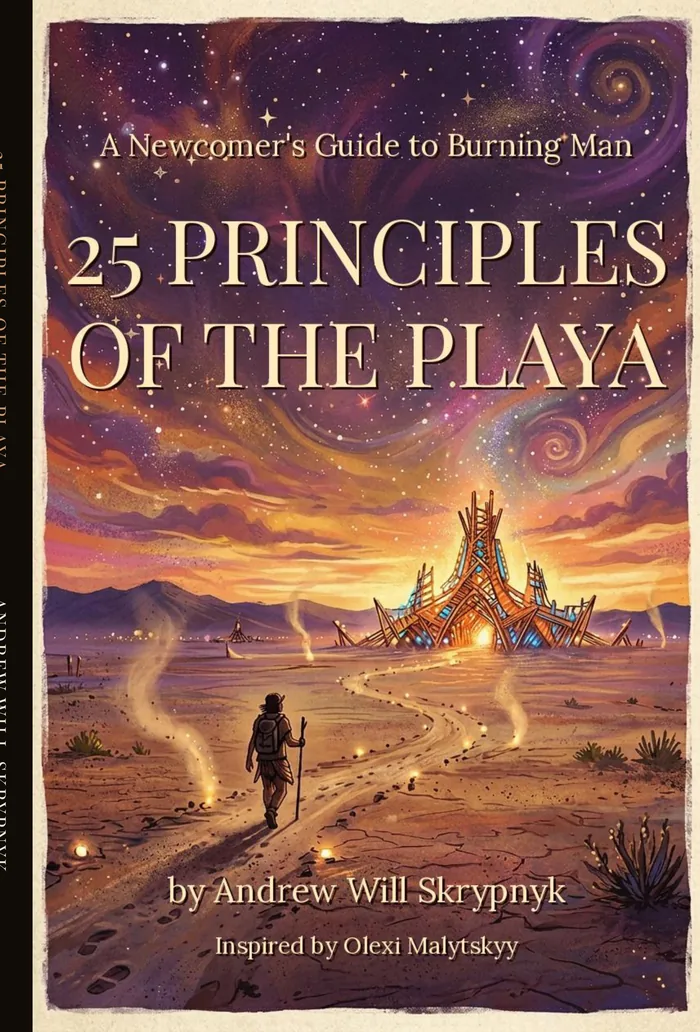
The digital version stays completely free, forever. For those who want the weight of a real book on the shelf, a beautiful gift for a virgin friend, or an e-reader copy to carry to the playa — the book is now available on Amazon in three formats.
📦 Printed and shipped by Amazon · Available worldwide